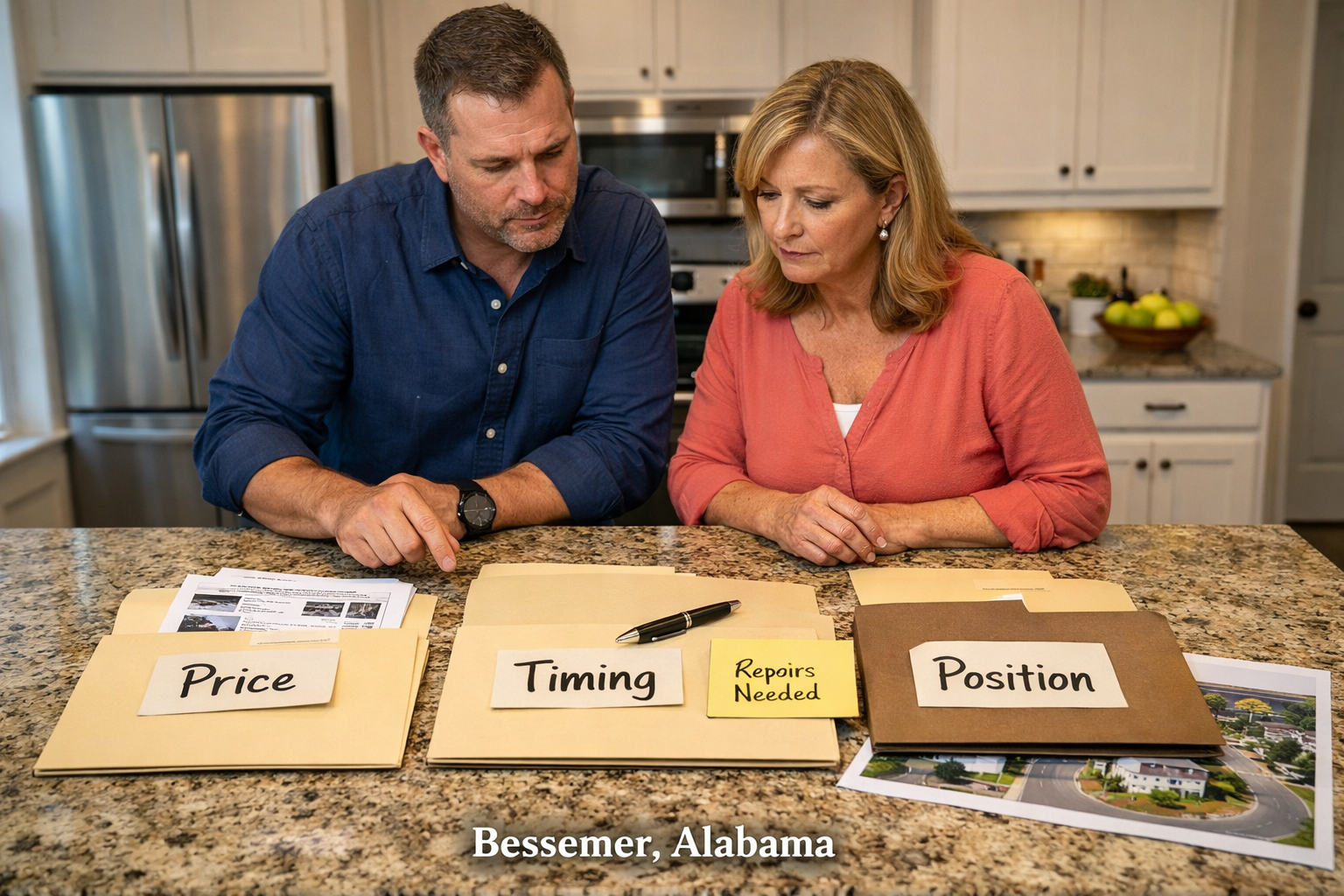
How The 96.1% Sale-To-List Ratio Is Changing The Pricing Conversation In Bessemer, Alabama
Key Takeaways
- A 96.1% sale-to-list ratio in Bessemer shows that buyers are still negotiating below asking price, which changes how sellers should price a home and how buyers should read market leverage.
- Days on market matter just as much as the asking price because longer exposure can weaken seller leverage, invite price reductions, and change the tone of negotiation.
- Project Marvel, industrial zoning changes, and infrastructure questions have raised public attention, though residential pricing is still being decided by closed-sale behavior, property condition, and neighborhood position.
- Parcel location matters in Bessemer because road access, nearby land use, buffer distance, and site placement can affect buyer confidence and resale appeal from one part of the city to another.
- Buyers, sellers, and investors need address-level analysis in Bessemer because citywide headlines do not tell the full story about pricing, timing, competition, or risk.
Introduction
Why The Pricing Conversation Has Changed
A great many market stories arrive dressed in brass buttons and parade uniforms, announcing growth, ambition, and the splendid future before the doors have even been fitted to the frame. Residential pricing behaves in a plainer manner. Buyers do not purchase headlines, and sellers do not deposit civic excitement at closing. Redfin’s February 2026 market page for Bessemer reports a 96.1% sale-to-list ratio, a median 120 days on market, and homes going pending in about 107 days over the prior three months, facts that place the city’s pricing conversation on firmer ground than rumor or flourish.
Such figures cast a stricter light over the whole affair, stripping away the vanity that so often gathers around an asking price and leaving the market to speak in its own plain, unsentimental voice. A house may enter the market dressed in fresh paint, careful staging, handsome photography, and language polished to a shine, yet none of those ornaments can force a buyer to forget an awkward floor plan, deferred maintenance, a less-favored street, or stronger competition a few blocks away. Every serious purchaser arrives with a ledger in their mind, weighing roof age against price, lot position against convenience, interior condition against likely repair bills, and the subject property against every comparable listing that offers a truer bargain or a cleaner future. The seller must then face a hard and ordinary truth: the list price is not a proclamation that compels agreement, but only the first demand in a negotiation that will be judged by the property’s condition, its surroundings, the available alternatives, and the patience of the buyer standing on the other side of the table.
Public attention has also been drawn toward matters beyond the front porch, and that fact has altered the texture of the conversation. Development plans, industrial land use, road alignments, and buffer distances now sit much closer to ordinary pricing talk than they did a year ago. A market under that kind of scrutiny becomes more exacting, not less, because buyers begin to ask harder questions about what lies near a property, what may rise behind it, and what the next purchaser may one day think of the same address. The result is a pricing climate that punishes carelessness, exposes exaggeration, and demands that list prices answer to the realities of both the property and its setting.
Why This Topic Matters To Buyers, Sellers, And Investors
A buyer feels the force of this subject at the very first turn of negotiation. Price determines far more than pride at the moment of acceptance; it shapes the monthly payment, the cash left for repairs, the tolerance for future uncertainty, and the margin for error if the property proves more demanding than it first appeared. A market where typical closings land below asking price does not grant permission for reckless low offers, though it does warn against treating every list price as sacred. Sensible buyers read prices beside market time, nearby sales, physical condition, and neighborhood position, because each one changes the meaning of the number attached to the listing.
A seller confronts the same matter from a different doorway. The asking price is not a decorative ribbon placed upon the house in the hope that admiration alone will do the work of proof. Municipal decisions and development plans have made that proof more difficult in certain parts of the city, because buyers are now weighing not only the dwelling itself but also what may stand near it, travel past it, or alter the character of its surroundings. Updated reporting on Project Marvel in February 2026 stated that the proposed campus had expanded to 1,600 acres and included 300-foot residential setbacks on three sides, details that gave location, adjacency, and site layout a heavier place in residential decision-making.
An investor must examine this matter with a discipline even harsher than that required of the ordinary buyer or seller, because sentiment has no power to rescue a deal once the numbers have turned against it. The price paid at acquisition determines not only the room available for repairs and improvements, but also the burden of carrying costs through every month the property remains unfinished, unleased, or unsold, and each of those burdens grows heavier when the resale market refuses to honor a hopeful projection. A grand public tale of growth may cast a flattering light across the city, though an investment is judged at last by the stubborn particulars of a single address: the street on which it stands, the condition in which it is acquired, the competition it must face at resale, the time required to bring it to market, and the price a future buyer will actually consent to pay. That is why the pricing conversation matters so deeply in Bessemer at this moment, for the difference between aspiration and market acceptance does not live in theory or civic excitement, but in the hard interval between purchase and disposition, where profit is narrowed or preserved by the precision of the original numbers.
The Number At The Center Of The Pricing Conversation
What A 96.1% Sale-To-List Ratio Means In Practical Terms
A sale-to-list ratio measures the relationship between the price a home was offered for and the price it actually achieved at closing, which makes it one of the clearest tests of whether asking prices are being accepted, resisted, or negotiated downward. A ratio of 96.1% means the typical closed sale is landing below the original asking price rather than meeting it in full, and that gives the figure practical force the moment a listing enters the market. A seller may admire the number written on the sign in the yard, though the ratio concerns the figure that survives inspection, comparison, negotiation, and the buyer’s final willingness to proceed. Recent Redfin data for February 2026 places the Bessemer sale-to-list ratio at 96.1%, which means the market has been closing the usual transaction at less than full asking price rather than rewarding list price as a settled fact.
That plain measure affects asking prices at the very beginning of the process. A sensible list price in a market like this cannot be chosen as though every buyer will treat it as a tribute due upon demand, because the recent pattern of closings suggests that many buyers are still negotiating from the far side of the seller’s ambition. The number does not command a fixed discount on every address, since condition, street position, renovation level, lot utility, and competition from nearby homes will still alter the outcome, though it does warn against treating list price as self-proving. An owner studying recent behavior in Bessemer must reckon with the possibility that an inflated price does not merely invite a lower offer, but may begin the entire transaction from a point of distrust.
Offer strategy is shaped by the same figure from the buyer’s side of the table. A purchaser reading the market with care will not use the ratio as a crude excuse to slash at every listing, though the number does suggest that negotiation has not been banished from the city’s residential transactions. Buyers can look at days on market, visible condition issues, price reductions, and the strength of nearby alternatives to judge whether a particular home is likely to face the same resistance reflected in the broader pattern of closed sales. The ratio matters because it turns vague market talk into a more disciplined question: not what a seller wishes to receive, but what a buyer has lately agreed to pay once the full circumstances of the property are brought into view.
Why This Figure Does Not Support Automatic Pricing Power
Public excitement around industrial expansion, municipal votes, and large development plans can tempt sellers into believing that the whole city has entered a season of easy pricing power, though verified transaction activity tells a stricter tale. A ratio below full asking price matters precisely because it shows that buyers are still pushing back against price, and pushback is the opposite of automatic seller control. The market page for Redfin also reports that homes in Bessemer sold after a median 120 days on market in February 2026, that the average home sold about 4% below list price, and that 32.0% of homes had price drops, all of which point toward negotiation, recalibration, and resistance rather than broad pricing freedom.
That distinction is especially important in a city where public conversation has been colored by Project Marvel, industrial zoning changes, and the expectation that growth alone must lift every roofline with it. Closed-sale behavior refuses to flatter such a simple story. A city may attract attention for what is proposed, debated, or approved, though the residential market is judged by what buyers do when confronted with the actual price, the actual location, the actual condition, and the actual competing inventory. Automatic pricing power would mean that sellers could rely on the surrounding narrative to carry asking prices upward with less resistance than before, yet a sub-100 sale-to-list ratio points in the opposite direction by showing that many transactions still require the seller to yield ground.
No serious reading of current performance can treat all properties as though they now possess the same advantage merely because large projects have entered the public eye. A house near a corridor of uncertainty, a property with visible deferred maintenance, or a listing priced above nearby competition may still find the market cool to its expectations no matter how impressive the broader headlines may sound. The ratio below full asking price matters because it restores proportion to the conversation, drawing attention back to the stubborn particulars that have always governed real estate in the end: where the home stands, how it compares, what condition it presents, how long it sits, and what price a buyer will finally accept as fair.
How Market Pace Is Showing Up In Listing Performance
What The Current Days-On-Market Pattern Reveals
Market time shows how long a property remains exposed before a contract is secured, and that measure reveals something more delicate than simple delay. It shows whether buyers are moving with urgency, whether sellers are asking the market for more than it is prepared to grant, and whether the available homes are winning confidence quickly or slowly. A city where listings move briskly presents one kind of negotiation, while a city where homes remain visible for longer periods presents another, and the difference is felt in every showing, every second visit, and every unanswered inquiry. Realtor.com reported a median 54 days on market for homes in Bessemer in January 2026, described the city as a buyer’s market, and stated that homes sold for 2.21% below asking price on average, which places current listing performance in a setting where urgency has not overtaken caution.
That pace matters because time on the market acts as a public clock, and every day visible on the board changes the way a property is read. Buyers seeing a home linger in Bessemer are not merely counting time; they are asking why it has lingered, whether the condition is weaker than expected, whether the layout has limited appeal, whether the street is less favored, or whether the price has been pitched too high for the competition surrounding it. Sellers who study the market closely must reckon with that same clock, because a home that remains active too long can begin to invite skepticism even before a flaw is discovered in person. Listing duration, then, is not a side note to pricing but part of the evidence by which the market decides whether the asking figure deserves respect.
Time on market belongs beside sale-to-list performance because the two measures speak to one another with remarkable plainness. A market can show price growth in one corner of the report and still reveal negotiation pressure in another, and the pairing of those numbers gives a truer picture than either figure standing alone. Long exposure can signal that buyers are not in haste, while a sale price that closes below asking confirms that patience has translated into bargaining power rather than evaporating at contract. Current listing performance in Bessemer is best read through that union of pace and price, since the days a home remains available help explain why sellers are not always receiving the number first attached to the listing.
How Longer Exposure Changes The Tone Of Negotiation
A listing that remains active for an extended period begins to speak before the seller says another word. Fresh listings are often approached with curiosity and a degree of grace, because buyers assume the market has not yet rendered its judgment; older listings are approached with a different cast of mind, one shaded by doubt, comparison, and the suspicion that the property has already been measured by others and found wanting in some respect. Zillow’s February 28, 2026 market page for Bessemer showed 142 homes for sale, 37 new listings, and a median 36 days to pending, figures that place individual properties in a wider field where buyers can compare, wait, and return on their own terms rather than rush at the first opportunity.
That longer exposure changes negotiation by altering confidence on both sides. Buyers grow less fearful of losing the home to a rival when it has already sat through weeks of viewings without a contract, and that reduced fear can lead to firmer demands over price, repairs, closing costs, or inspection issues. Sellers, on the other hand, may feel the burden of time pressing upon mortgage payments, insurance costs, utilities, upkeep, and the simple discouragement that comes from watching the listing age in public view. Once that burden settles in, the tone of negotiation often shifts from confident defense of the asking price to a more practical effort to bring the matter to an end on terms the market will accept.
Price reductions are not the only consequence of long exposure, though they are among the most visible. Confidence itself can change shape around a listing that has lingered, because buyers begin to assume that prior visitors saw something troubling, that the price has outrun the property, or that a better option may be found elsewhere in Bessemer’s active inventory. Such impressions are not proof of defect in every case, though they matter because residential markets are governed not only by brick, roofline, and square footage, but also by the confidence required to proceed from interest to offer. Longer exposure, for that reason, does not merely lengthen the calendar; it alters the very mood of the transaction, and that altered mood can weigh upon the final terms as surely as any visible flaw in the house itself.
Why Development Headlines And Closed Sales Are Telling Different Stories
How Project Marvel Changed Public Attention
Public attention sharpened when the proposed data-center campus ceased to be a distant sketch and became a matter of acreage, boundaries, hearings, and revised plans spread across the civic table. The Planning and Zoning Commission voted in February 2026 to recommend rezoning an additional 914 acres from agricultural to light industrial use, while the updated campus plan expanded the proposal to roughly 1,600 acres, kept the 18-building concept, increased residential setbacks to 250 to 300 feet, and placed the buildings outside the currently proposed Northern Beltline route. Those are not abstract planning notes fit only for committee minutes. They are the sort of details that draw the gaze of homeowners, buyers, and investors because they touch the map of daily life, the edge of neighborhoods, and the future reading of nearby residential property.
A project of that scale changes public attention because it changes the questions people ask before they speak of value. Homeowners near the proposal begin to think not merely of square footage and curb appeal, but of what may stand in the distance, what traffic patterns may alter, what utility demands may follow, and whether a future purchaser will approach the property with confidence or caution. Buyers, for their part, become more exacting in their study of location, not less, because a house is never purchased as a structure alone; it is purchased as a place, with all the neighboring uses, routes, and future possibilities that attend it. Investors look upon the same scene through a sterner instrument, asking whether an address will be carried by demand or pressed down by uncertainty when the time comes to sell.
Such attention matters because residential markets often suffer when public discussion outruns local precision. The mere presence of a large project in the news can tempt some observers to speak as though every property in the surrounding city has been granted a fresh layer of value by proclamation. Residential real estate does not submit to that sort of enchantment. A proposed campus of this size does not create one simple effect; it creates a patchwork of consequences, with some areas drawing confidence from access and employment narrative, while others are judged through adjacency, visibility, traffic concerns, and the unknown temper of future buyers. That is why Project Marvel altered public attention so forcefully: it turned pricing conversation away from broad civic optimism and toward the parcel, the corridor, the approach road, and the exact place where one use meets another.
What The March 2026 Zoning Amendment Added To The Debate
The March 2026 zoning amendment gave the debate a sharper edge because it moved the matter from speculative fear into adopted municipal language. City Council approved an update to the industrial zoning ordinance allowing some industrial buildings to reach 105 feet when they are set back farther from property lines, and city officials stated that the change was meant to require greater distance from nearby residential property if industrial structures rise taller. That sort of vote does not assign a sale price to any house, though it does alter the terms of the residential conversation by making height, distance, screening, and proximity more than casual talking points. Once those matters enter the ordinance book, they enter the pricing discussion as well.
Setbacks and buffers matter in residential real estate because distance changes perception, and perception has always carried weight in the market long before a buyer reaches the closing table. Two homes of similar age, size, and condition may be read very differently if one sits in a pocket where future industrial presence feels remote and screened, while the other occupies a position where scale, visibility, or access concerns feel closer at hand. Site placement matters for the same reason. A building permitted by ordinance may still have one effect when tucked away beyond meaningful separation and quite another when buyers imagine its form and activity in relation to the property they are considering. The conversation around pricing grows more delicate under such conditions because a seller can no longer rely on broad claims about growth without also answering the smaller question of where, exactly, that growth will sit.
Municipal action has therefore added discipline to the market even before every long-term consequence is known. A buyer weighing a home in or near a scrutinized corridor is likely to ask harder questions about what can be built, how far away it may stand, and whether the setting will feel settled or unsettled to the next purchaser in line. A seller in the same area must reckon with the fact that pricing is now judged not only by comparable sales and property condition, but by the confidence or hesitation created by nearby land-use change. That is why the zoning amendment matters to residential pricing without any need for exaggeration: it gives shape to the physical possibilities around a property, and once those possibilities take shape in the public mind, they begin to influence the terms on which buyers are willing to proceed.
Where Neighborhood Logistics Start To Matter More Than Headlines
Why Parcel Location Can Outweigh The Citywide Narrative
Within a single city, one address may be greeted with ease while another is received with a furrowed brow, and the difference often lies not in square footage or paint color but in the burdens and advantages carried by the ground around it. Project Marvel’s proposed expansion brought that truth into sharper relief because the conversation ceased to be about a vague development somewhere in the distance and became attached to actual places in southwest Bessemer, including land near Rock Mountain Lake Road and the concerns voiced by residents in nearby areas such as Red Mountain Heights and Rock Mountain Lakes. A house positioned near land under heavy public scrutiny enters the market with a different set of questions than a house tucked into a quieter pocket where the surrounding pattern of life appears more settled. Buyers do not inspect a roof and forget the road that leads to it, the neighboring tracts that frame it, or the future uses that may change the tone of the setting after the deed is signed.
Adjacency has a practical force that broad civic language cannot erase. A parcel near land planned for more intensive use may be read through possible traffic, visible infrastructure, or future industrial presence, while another parcel deeper within a residential pattern may be judged more by school run, shopping route, lot utility, and the ordinary comforts of routine. Road access enters the matter in the same unromantic way, because a simple daily approach and a clear path to major routes can steady buyer confidence, while uncertainty around nearby corridors can invite more caution at the offer stage. The citywide narrative may promise growth, though the parcel bears the burden of proving whether that growth feels beneficial, distant, inconvenient, or too close for comfort.
Neighborhood position shapes pricing because the market never purchases a municipal headline in the abstract. Buyers compare one street to another, one entrance route to another, one edge condition to another, and the judgment formed from those comparisons often governs the offer more than any grand discussion taking place at council meetings or on social media. One address may benefit from being far enough removed from public controversy to feel ordinary and dependable, while another may be burdened by its nearness to land whose future form still occupies the local imagination. Local variation, then, is not a minor footnote in Bessemer’s present market but a daily fact of how homes are weighed, doubted, favored, or set aside.
How Buffer Distance And Site Placement Affect Buyer Perception
Distance on a site plan may appear to some as a matter fit for engineers and planning staff, yet it is read by buyers in a far more human way, as a question of comfort, exposure, and future salability. City leaders stated in the revised Project Marvel framework that the plan was changed in response to concerns about proximity to residential areas and the planned Northern Beltline, with larger buffers, more green space, and a layout intended to position buildings outside the currently proposed corridor. That language matters because boundaries, setbacks, and access points do not remain trapped on planning documents; they travel directly into conversations at showings, kitchen tables, and inspection periods. A buyer trying to picture life at a property near a debated corridor is not merely measuring feet on paper but imagining what can be seen, heard, approached, and later explained to the next purchaser.
Nearby owners watch those details so closely because the eye of the market is rarely satisfied by assurances alone. A setback can soften concern if it is substantial and clearly understood, though uncertainty about where the true edge lies or how the site will function can unsettle an otherwise capable listing. Access points matter for much the same reason, since buyers tend to judge not only what may be built but how activity will move in relation to the home they are considering. Seller messaging grows more difficult when the physical relationship between a house and nearby development still feels unsettled in the public mind, because every unanswered question invites the buyer to protect against uncertainty in the price offered.
Perception in such a setting is formed through distance, visibility, and confidence in the final arrangement of the land. A home that feels comfortably separated from change may still be judged on its own merits, while a home that seems too closely tied to an unsettled boundary may have to overcome caution before any other virtue is allowed to speak. Public planning activity around Project Marvel has given those smaller geographic details unusual weight in Bessemer, and that weight falls unevenly from one property to the next depending on how clearly the separation can be seen and trusted. The practical effect is plain enough: where placement feels clear, buyers can proceed with steadier nerves, and where placement still feels uncertain, pricing often has to bear the burden of that doubt.
The Financial Questions Residents Are Still Asking
Who Pays For Utility And Infrastructure Expansion
The financial unease surrounding Project Marvel is not confined to tax rolls and ribbon-cutting speeches, but reaches into the humbler and more immediate realm of household bills, utility reliability, and the physical systems that must be enlarged before a project of this scale can be served. Reporting from the November 2025 council vote stated that discussions were ongoing with Warrior River Water Authority and Jefferson County Sewer, that capital improvements would be needed for those systems, and that the developer said those improvements would be funded by the project in order to meet its utility demand. That sentence did not end the matter for nearby residents, because the ordinary reader of such news can distinguish between a statement made in support of a project and a settled public accounting that answers every practical question. Power, water, sewer capacity, transmission, and related infrastructure do not appear out of the ground by magic, and once those needs are named in public, households begin asking who bears the burden if the demands grow larger, the systems require more work, or the promises first made prove narrower than they seemed.
Residential conversation has absorbed this question because utility expense is not a distant abstraction for people deciding where to live, what to pay, and how much uncertainty they are willing to carry. A buyer considering a house near the Rock Mountain Lake Road corridor is not only measuring bedrooms and roof age, but also judging whether nearby infrastructure demands may become part of the property’s future atmosphere, whether through construction activity, service questions, or the broader fear that large-scale utility upgrades rarely remain invisible to the communities around them. A seller in the same geography cannot ignore that buyers are listening for plain answers on matters once thought too technical for the front porch, because the household budget is where planning language is eventually translated into lived concern. This is why the question of who pays has entered residential talk with such force: utility systems serve homes before they serve headlines, and once those systems become part of a major project’s story, the housing market begins to listen.
Public reporting and local discussion have not produced one simple ledger that closes the subject, and that absence is precisely what keeps the question alive. Some parts of the record point to developer responsibility for specific improvements, while the broader public conversation has kept circling the possibility of cost burdens that could travel through rates, service systems, or other forms of local strain if safeguards are weak or public detail remains incomplete. Households do not need a formal rate case in hand before they begin to worry over such matters; they need only enough public information to know that very large utility demand is being discussed near residential areas. The question persists, then, not because every consequence has been proved, but because enough has been said in public to make ordinary residents ask where the burden stops and who, in the end, is expected to carry it.
Why Cost Uncertainty Can Affect Residential Decision-Making
Cost uncertainty affects residential decision-making because homes are purchased and sold inside budgets, not outside them, and uncertainty has a way of enlarging every number that is already difficult to bear. Concern over that burden moved beyond neighborhood rumor and into Montgomery when WBRC reported on February 5, 2026 that Senate Bill 270 was written to force utilities to make large data centers pay the extra costs they create, with the broader package described as an effort to keep everyday ratepayers from footing the bill for big tech facilities. Once lawmakers begin drafting protections around utility cost allocation, the question is no longer a private anxiety held only by a few nearby residents; it becomes part of the climate in which buyers and sellers evaluate risk. A household comparing one home to another may not know the final answer to every utility question, though it can plainly see that the issue has become serious enough to reach the statehouse.
Buyers often react to unresolved cost questions with caution rather than drama. A property does not need to come with a proven future rate increase attached to it for uncertainty to affect the offer; hesitation may arrive earlier, in the form of a lower price, a longer decision period, or a choice to purchase in a less scrutinized part of the city. Seller positioning grows more delicate under the same conditions, because confidence is harder to sustain when a buyer suspects that nearby infrastructure demands remain under public debate. The result is not a theatrical collapse of value, but a quieter and more familiar market response in which uncertainty becomes one more reason to negotiate, delay, or favor a competing property that seems less burdened by unanswered questions.
Current pricing conversation is shaped by that caution because residential markets rarely wait for perfect clarity before adjusting their tone. A buyer weighing a house near an area of active utility discussion may decide that the prudent course is to protect against the unknown rather than pay a premium for optimism, while a seller may discover that broad talk of future growth does not dissolve the buyer’s concern over present financial ambiguity. Cost uncertainty does not need to be proved as a future bill on a specific date to affect the market; it need only be credible enough, public enough, and unresolved enough to enter the judgment of the next person considering the property. That is why these financial questions matter so much in the present moment, for they do not sit apart from residential pricing but move quietly inside it, influencing how confidently one side asks and how cautiously the other side answers.
What Buyers Need To Watch In This Market
How Buyers Should Read Price Versus Time On Market
Price and market time must be read together if a buyer intends to make sense of what a listing is truly asking rather than merely what it is publicly declaring. A number printed at the top of a listing can look confident, polished, and complete, though the calendar often tells whether that confidence has been shared by the market or quietly challenged by it. A home that appears fresh and fairly placed may deserve a very different reading from one that has sat through weeks of exposure while comparable options continue to appear around it. Current buyer behavior in this city makes that distinction especially important because the time a property remains available can reveal tension between the seller’s expectations and the market’s willingness to meet them.
A careful buyer should examine whether the list price still stands in its original posture or has already begun to bend under the pressure of time. If a property has lingered, if reductions have appeared, or if comparable homes with similar condition and neighborhood position have moved more quickly, the listing may be signaling that the market has resisted the initial figure. That does not mean every older listing is a bargain, since some homes sit because of layout problems, repair burdens, awkward sites, or limited buyer appeal, though it does mean that time can uncover negotiation room where the price alone might pretend none exists. Active Bessemer listings on Zillow in mid-March 2026 showed this pattern in plain sight, with some homes carrying recent price cuts while others had remained listed for 40, 199, 317, and even 431 days, a spread that gives buyers far more to study than the asking figure by itself.
Negotiating room is usually found where price, condition, and exposure have fallen out of harmony with one another. A buyer watching the market closely may notice that a solid house priced well and placed on a favored street can move with surprising firmness, while a weaker property in a less persuasive position may begin to soften after enough days have passed under public view. The practical task is not to chase age on market as though it were treasure in itself, but to compare it against the property’s merits, the alternatives nearby, and the degree to which reductions or long exposure suggest that the seller is no longer bargaining from a place of complete command. That sort of reading belongs to the present market in Bessemer because the buyer who studies time beside price is often closer to the truth of a listing than the buyer who studies price alone.
Why Buyers Need Neighborhood-Level Screening
A serious purchase decision in this city cannot be made through a citywide headline, because one part of town may be tied more closely to interstate access, medical employment, and newer residential patterns, while another may be read through older housing stock, different commute burdens, or nearness to land under active public debate. A buyer choosing between 35020, 35022, and 35023 is not merely choosing among postal codes, but among distinct sets of roads, daily routines, property conditions, and surrounding land-use influences that shape how a home feels to own and how it may be judged later by the next purchaser. Site proximity matters because the same square footage can live a different life depending on whether the property sits near established residential calm, close to major access points, or in a corridor where buyers are already asking harder questions about future surroundings. Housing condition matters just as much, since older stock in one pocket may bring more repair exposure at the same moment another pocket offers a higher price but a smoother daily pattern of use and travel.
Commuting patterns deserve close attention because convenience is not a decorative luxury in this market; it is part of the property’s actual appeal and part of its eventual resale position. A buyer working in Hoover, Birmingham, McCalla, or the medical corridor must weigh not only map distance, but the ease of getting in and out of the neighborhood at ordinary working hours, the clarity of the route, and the degree to which that route will still feel dependable a year or three years from now. Nearby land-use activity must be screened with the same care, because a house bought under the spell of a low price can become a more expensive choice if the surrounding setting proves less stable or less comfortable than it first appeared. A citywide growth narrative cannot answer those local questions, and a buyer who lets it try is likely to mistake atmosphere for analysis.
Detailed local screening is what turns a purchase from a hopeful gesture into an informed act. Access to UAB Medical West from the McCalla–Bessemer side is routed directly through I-459 Exit 1 and Bell Hill Road, while access from Birmingham runs through I-20/59 to I-459, facts that show how strongly road position and daily movement can shape the appeal of homes in the 35022 corridor when compared with other parts of the city. That sort of detail matters because the market does not reward a house simply for existing inside Bessemer’s city limits; it rewards or discounts a house according to the life that can be lived from that address, the ease with which buyers can place it within their routines, and the degree of confidence they feel about what surrounds it now and what may surround it later.
What Sellers Need To Face Before Setting A Price
Why Aspirational Pricing Can Backfire
A seller may enter the market persuaded that confidence itself can create value, that a bold asking price will somehow summon the right buyer by sheer force of will, and that the crowd of public talk around growth and development will do the rest. Residential pricing does not behave with such courtesy. A number set above what current conditions can support often does not lift the home into a higher class of buyer; it leaves the property standing too long before the wrong audience, invites unfavorable comparison with sharper listings, and gives the market time to form doubts that might never have arisen had the price begun in a more disciplined place. Every extra week of exposure can turn what was meant as a show of strength into an advertisement for misalignment between the house, the neighborhood, and the number attached to it.
Buyer resistance tends to grow in public, not in secret. A listing that sits while other homes move begins to gather a history that can be read from the outside: days ticking upward, reductions appearing, relistings or status changes catching the eye, and a widening suspicion that something is wrong with the property or the seller’s expectations. A home in the 35020 side of the market may be judged against older stock with different condition burdens than a home closer to the 35022 corridor, yet in either setting the same principle governs the result: once the asking price drifts above what nearby competition and visible condition can defend, the market usually becomes more skeptical with each passing interval. The problem is not merely that offers come in lower, but that a stale listing can weaken the seller’s position before the first serious offer ever arrives.
Current market behavior in the city gives that risk a measurable form rather than leaving it as a matter of cautionary folklore. Homes.com reports that homes in Bessemer have been selling after an average of 65 days on market, with a median list price of $245,000, a median sale price of $234,950, and a median change from first list price of 2%, which shows that sellers have not been receiving a market that routinely rewards overreach or quickly rescues inflated pricing decisions. A seller who begins too high may therefore lose more than time alone, because long exposure can push the eventual negotiation into a weaker posture than a well-supported price would have faced on the first week of listing.
How Sellers Can Separate Hope From Verifiable Competition
Hope must be made to stand beside evidence before a list price deserves to be taken seriously. The evidence a seller needs is not found in civic excitement, not in a rumor of future growth, and not in the private affection every owner naturally feels for a home long occupied and carefully kept. Active competition matters because buyers are comparing what is available right now, not what a property might have commanded under different conditions six months ago or what a neighbor believes it ought to be worth. Recent closings matter because they show what real buyers have actually accepted in similar circumstances, while neighborhood-specific conditions matter because a house off one corridor, near one school pattern, or close to one type of surrounding land use may be read very differently from another property carrying the same bedroom count across town.
A disciplined seller in this market must therefore look beyond the comforting fiction that all homes inside the city limits are rising or struggling together in one neat formation. Core neighborhoods with older housing stock, McCalla-leaning areas in the 35022 corridor, and properties nearer public debate over future land use do not enter the market under identical terms, and price must reflect those distinctions rather than ignore them. A seller near a more scrutinized pocket may need stronger proof through condition and price discipline, while a seller in a steadier residential setting may be able to rely more heavily on ordinary comparable logic. Development talk can shape attention, though it cannot substitute for the hard work of comparing the subject property against what buyers can tour this week and what similar homes have already achieved at closing.
Recent market inventory shows why direct comparable evidence must take precedence over broad narrative. Homes.com reports 310 homes for sale in Bessemer, 799 home sales over the last 12 months, 4.70 months of supply, a median list price of $245,000, and a median sale price of $235,000, all of which means a seller is stepping into a field of visible alternatives and documented outcomes rather than a stage empty enough for wishful pricing to go unchallenged. A seller who separates hope from verifiable competition does not price the home according to civic mood, but according to the actual homes a buyer can choose instead, the actual sales already recorded nearby, and the actual neighborhood conditions that make one Bessemer address perform differently from another.
What Investors Need To Measure Before They Underwrite A Deal
Why A Citywide Story Is Too Broad For Investment Decisions
An investor buying residential property in this city cannot afford the luxury of a single sweeping story, because the arithmetic of a deal is not settled by municipal reputation but by the exact ground on which the property stands and the buyer pool it must later attract. One address may draw from households seeking a shorter route toward McCalla, Hoover, or the hospital corridor, while another may depend more heavily on buyers comfortable with older housing stock, smaller price points, and a different set of repair tolerances. The same broad headline may pass over both roofs, though the exit audience, the acceptable renovation budget, and the margin for error can differ sharply between them. A prudent underwrite must therefore begin not with the city in the abstract, but with the particular street, competing inventory, likely resale audience, and the conditions that will govern that property on the day it comes back to market.
Neighborhood position is especially important because resale demand is not evenly distributed simply by virtue of a Bessemer address printed on the contract. Residential investment succeeds when the next buyer can be identified with some seriousness before the first closing ever takes place, and that requires more than noticing growth talk or public excitement around development. A property closer to the 35022 side of the market may pull from a buyer profile and price band very different from one more closely tied to older core inventory, and that difference changes renovation choices, acquisition ceiling, and expected hold period before resale. Redfin’s February 2026 data for 35022 showed a median sale price of $314,950, 81 homes sold, and an average 110 days on market, which is enough by itself to show that one portion of the city can operate on a different resale scale and timing profile than a simple citywide narrative would suggest.
Exit timing becomes fragile when an investor mistakes public enthusiasm for universal demand. A house purchased too aggressively in the wrong pocket may be renovated to a standard the neighborhood does not reward, then brought back to market before the local buyer pool is ready to absorb it at the number required to protect the spread. Another address, chosen with closer attention to route patterns, surrounding condition, and likely owner-occupant demand, may justify a very different plan even if the two houses sit under the same municipal banner. Residential investment logic in this city is therefore granular by necessity, because the distance between a sound deal and a wounded one often lies in the difference between one cluster of streets and another, one resale audience and another, one practical location and another.
How Market Friction Can Alter Exit Timing
Market friction reveals itself in the small delays and resistances that quietly lengthen an investor’s hold beyond the neat schedule imagined at acquisition. A project may appear profitable on paper when the purchase closes, the contractor begins, and the projected resale date is written with confidence in the margin, though the market has a habit of pressing back through slower showings, heavier negotiation, buyer requests that expand repair scope, and a resale period longer than the original underwrite allowed. Each added week carries cost with it through interest, insurance, utilities, taxes, upkeep, and the simple wearing down of margin that comes when time ceases to serve the investor and begins to feed on the deal. A disciplined investor must account for that possibility before purchase rather than discovering it after renovation money has already been spent.
Price negotiation is part of that friction, and its effect on exit timing is often underestimated because many investors focus too narrowly on the resale number and too little on the path required to reach it. A property returning to market in a slower-moving environment may need more time to locate the right buyer, and that extra time can alter the final result even if the eventual sale still looks respectable to an outsider. Reduced confidence among buyers, stronger comparison against competing listings, and a smaller willingness to absorb every cosmetic upgrade at full retail can force the investor to choose between more patience and less profit. The underwrite must therefore treat market pace and price resistance as living parts of the exit plan rather than as inconveniences to be brushed aside by optimism.
That caution is especially warranted where resale depends on a thinner buyer pool and a price band that leaves little room for error. January 2026 market data for the 35020 ZIP code showed a median home sale price of $99,900 and a median 50 days on market, figures that place investors in a resale environment where timing and price discipline can carry unusual weight. An acquisition in that range can be wounded quickly when the purchase price is too high, the renovation scope grows too ambitious for the neighborhood, or the expected resale figure leaves no cushion for a slower disposition. Market friction, in such a setting, is not an inconvenience arriving from outside the deal after the work is done, but a condition present from the beginning, waiting to narrow the spread if the underwrite has not allowed enough room for delay, negotiation, and the sober habits of the local buyer.
How LAS Companies Of KW Hoover Fits This Conversation
Why LAS Companies Of KW Hoover Focuses On Practical Market Analysis
A residential buyer, seller, or investor moving through this market usually needs more from a real estate agent or Realtor® than encouragement and broad talk of momentum. Pricing in this city is pressed by neighborhood position, property condition, listing pace, access routes, and the buyer’s judgment of what surrounds the home, which means a serious agent must work from evidence before language. Set against that reality, LAS Companies of KW Hoover centers valuation, due diligence, neighborhood logistics, and transaction discipline because those are the very places where residential decisions in Bessemer tend to go right or go wrong. A seller pricing a house near older stock in 35020, a buyer weighing commute access on the 35022 side, and an investor studying resale risk near active land-use debate each require a method built on particulars rather than one built on comfort.
Valuation sits at the center of that method because a list price must be earned before it can be defended. Comparable selection in Bessemer cannot be done carelessly when one cluster of streets carries a different condition profile, traffic pattern, or buyer pool from another only a short drive away. Due diligence follows naturally from that same discipline, since a house must be read through deferred maintenance, lot utility, street position, route logic, nearby land-use activity, and the contract behavior likely to emerge once a buyer begins comparing alternatives. Neighborhood logistics matter for the same reason, because the practical value of an address depends not only on the structure itself but on how the property sits within daily life and how the next buyer is likely to judge that placement.
Transaction discipline gives that work its final shape. Negotiation in a market like this requires a real estate agent or Realtor® who can distinguish between a price that has support and a price that is merely being hoped into existence, between a concession that protects the deal and one that gives away ground without purpose, and between a property that can withstand scrutiny and one that must be approached with greater caution from the beginning. Buyers, sellers, and investors in Bessemer are often making decisions under the weight of condition issues, neighborhood variation, commute logic, and shifting public attention around nearby development, which is why the work must remain grounded in valuation and due diligence rather than sales language. That practical method is reflected in the way LAS Companies of KW Hoover frames residential real estate through home valuation, buyer representation, seller representation, market analysis, and investor-focused guidance tied to local conditions.
Where LAS Companies Of KW Hoover Adds Precision In Bessemer
Precision in this market begins where vague pricing talk ends. A buyer looking at two houses with similar square footage may be standing before very different assets once condition, access, surrounding use, and resale audience are examined with care. A seller may believe a development headline justifies a higher number, though a disciplined reading of comparables can show that the neighborhood, finish level, or location does not support the leap. In that setting, LAS Companies of KW Hoover adds value by framing price through closed sales, present competition, repair sensitivity, street-level position, and the pace at which similar homes are actually moving rather than through language meant only to flatter the listing.
Condition matters because Bessemer does not offer one uniform housing stock behaving in one uniform way. Older pockets can carry a very different inspection and repair profile from areas influenced by newer construction or stronger commuter appeal, and that difference must be reflected in how a property is priced and presented. Neighborhood position matters for much the same reason, since the same kitchen renovation or bedroom count may carry a different market effect depending on whether the address sits in a steadier residential pocket, along a more heavily traveled route, or closer to land uses that prompt added buyer questions. Local market pace sharpens every one of those distinctions, because a property entering the market at the wrong number in the wrong position often gives away negotiating power before the first strong offer is ever written.
That precision also shows up in the way micro-markets are separated instead of blended into a citywide average that tells very little about a specific address. Work tied to the Medical West corridor has been framed through drive-time logic, comparable bracketing, condition weighting, and appraisal-grade due diligence that treats small pockets of Bessemer as distinct markets with distinct pricing behavior rather than as one indistinct mass. Such an approach fits the present pricing conversation because the 96.1% sale-to-list ratio has already shown that this market rewards evidence and punishes laziness, and a real estate agent or Realtor® working in Bessemer must be prepared to meet that standard at every stage of the transaction.
Conclusion
Why Closed-Sale Behavior Carries More Weight Than Headline Excitement
Public excitement has a habit of arriving in splendid dress, full of promise, volume, and certainty, while the closing table keeps to a stricter costume and speaks in a quieter tone. The buyer who signs does not purchase the mood of the city, nor the seller who lists a home receives payment in applause for a proposed project. A house is still judged by its condition, its setting, its competition, and the confidence it can inspire when a real person must bind money to the deed. That is why the sale-to-list ratio at the center of this article carries more authority than the noisiest public conversation around growth.
The 96.1% figure discussed throughout this article matters because it points to the same restraint shown in other current market readings that still place Bessemer below full asking-price performance rather than in a condition of automatic seller command. January 2026 market data showed homes in the city selling at 94.89% of asking price, with 106 days on market and only 17.65% of homes selling over asking price, a pattern that keeps the market on the side of negotiation rather than unchallenged pricing freedom. A seller may be heartened by industrial headlines, zoning votes, and public enthusiasm, though the buyer remains occupied with a smaller and more practical catechism: what is this home worth beside the others, what trouble may be hidden in its walls or its location, and what reason is there to pay the full figure asked. Closed-sale behavior answers those questions with more honesty than civic excitement ever will.
Verified transaction behavior deserves the heavier weight because it records what the market has already endured and accepted, not what it merely imagines may happen next. A ratio below full asking price does not pronounce doom upon the city, nor does it deny that some homes will still command firmness where condition, neighborhood position, and buyer demand align in their favor. It does, though, place a necessary restraint upon inflated expectations and draw attention back to the stern little facts from which every serious price must take its leave. Market evidence in this city has been telling a more measured story than the headlines, and anyone who ignores that difference risks mistaking motion in public discussion for power in an actual transaction.
Why Property-Specific Pricing Will Decide The Next Move
The next move in this market will be decided property by property, street by street, pocket by pocket, because that is how residential pricing has always rendered its final judgment when a city contains uneven conditions under one municipal name. A buyer choosing between an older house in a more price-sensitive corridor and a better-positioned property nearer stronger commuter appeal is not comparing two abstractions, but two futures with different costs, different comforts, and different resale prospects. A seller preparing to list cannot borrow confidence from a headline if the driveway, the surrounding land use, the repair burden, and the competing inventory do not support the number. An investor working from a thin margin can be right about the city and still be wrong about the address, which is why local context matters more than broad optimism at the moment of underwriting or resale.
Listing pace, neighborhood logistics, and property-specific context will continue to govern the bargaining table because each one changes how a buyer reads risk. A house that enters the market clean, well-placed, and sensibly priced may still draw confidence even in a city where negotiation remains alive, while a house carrying location friction, unresolved condition issues, or an ambitious price will often surrender ground more quickly than the owner expected. Commute routes toward McCalla, Hoover, and the Medical West corridor matter. Proximity to debated land use matters. The visual and practical separation between a home and its surroundings matters. That is the plain discipline of the market now, and it is not likely to be overturned by rhetoric.
Work performed by the real estate agents and Realtors® at LAS Companies of KW Hoover is built for exactly that kind of market, where one broad average tells too little and one wrong assumption can wound a price before the first offer is written. Pricing and representation are approached through comparables, neighborhood position, condition, route logic, and the smaller distinctions that make one Bessemer address compete differently from another, the same local method reflected in the January 2026 market-split analysis that treated Bessemer as an entry-tier market with its own pace and liquidity rather than as a place to be flattened into countywide averages. That is the path forward from this article into actual practice: not louder claims, not easier language, but pricing and representation disciplined enough to meet the market as it is, on the exact ground where the property stands.
Frequently Asked Questions (FAQs) – How The 96.1% Sale-To-List Ratio Is Changing The Pricing Conversation In Bessemer, Alabama
1. What Does A 96.1% Sale-To-List Ratio Mean For A Home Seller In Bessemer?
A sale-to-list ratio at that level means the typical closing price is coming in below the asking price, which tells sellers that the market is still testing list prices instead of accepting them as fixed truth. The practical lesson is plain: an asking price must be supported by condition, location, and comparable sales, or the market is likely to push back.
2. Why Does Days On Market Matter Alongside Sale-To-List Ratio?
Days on market shows how quickly buyers are willing to act, while sale-to-list ratio shows how much price resistance they are bringing with them. Read together, those two measures reveal whether a listing is attracting confidence early or sitting long enough for buyers to grow skeptical and negotiate harder.
3. Why Are Development Headlines Not Enough To Justify A Higher Asking Price?
Public excitement around large projects can influence conversation, though a closing is still decided by the house itself, its setting, and the buyer’s view of risk. A seller cannot rely on growth talk alone when buyers are still comparing condition, location, nearby land use, and competing listings before deciding what the property is worth.
4. How Can Project Marvel Affect Residential Pricing Without Directly Setting Home Values?
A project of that scale changes how buyers read nearby areas because it raises questions about placement, traffic, buffers, access, and the future character of surrounding land. Home values are not assigned by the project itself, though buyer confidence and seller positioning can be affected when a property sits near land under active public scrutiny.
5. Why Does Parcel Location Matter So Much Inside The Same City?
One address may benefit from stronger access, calmer surroundings, and a more comfortable resale audience, while another may face harder questions about nearby land use, visibility, or daily route patterns. A city name on its own does not determine pricing, because buyers judge the exact setting of the property rather than the municipal label alone.
6. Why Are Buyers Paying Attention To Buffers, Boundaries, And Site Placement?
Buffers and boundaries matter because distance on a planning map becomes comfort or unease in a buyer’s mind. The closer a property appears to debate land use, access points, or future large-scale development, the more likely a buyer is to weigh that uncertainty into the offer.
7. Why Have Utility And Infrastructure Questions Entered Residential Conversations?
Large development proposals bring public attention to power, water, sewer, and other systems that serve both new projects and existing households. Once residents begin hearing about capacity, upgrades, and cost responsibility, those issues stop feeling remote and begin influencing how buyers and sellers think about financial stability around a property.
8. How Should A Buyer Read Price Cuts And Longer Listing Exposure In Bessemer?
Price cuts and extended time on market can signal that the original asking price did not match buyer appetite, the property’s condition, or the strength of nearby competition. That does not make every older listing a bargain, though it does tell a buyer to study the home more closely and judge whether the negotiation room has opened because of real market resistance.
9. Why Can Aspirational Pricing Hurt A Seller More Than Help?
An inflated asking price can leave a listing exposed too long, and a stale listing often invites doubt before the buyer even walks through the door. Once the market begins to read a home as overpriced, the seller may lose not only time but also leverage, because buyers start negotiating from the assumption that the price must come down.
10. Why Do Investors Need Address-Level Analysis Instead Of A Citywide Growth Story?
An investment succeeds or fails at the level of the specific property, not at the level of public excitement. Exit timing, resale demand, renovation scope, and margin are shaped by the street, the buyer pool, the surrounding uses, and the local competition that the finished property will face when it returns to market.