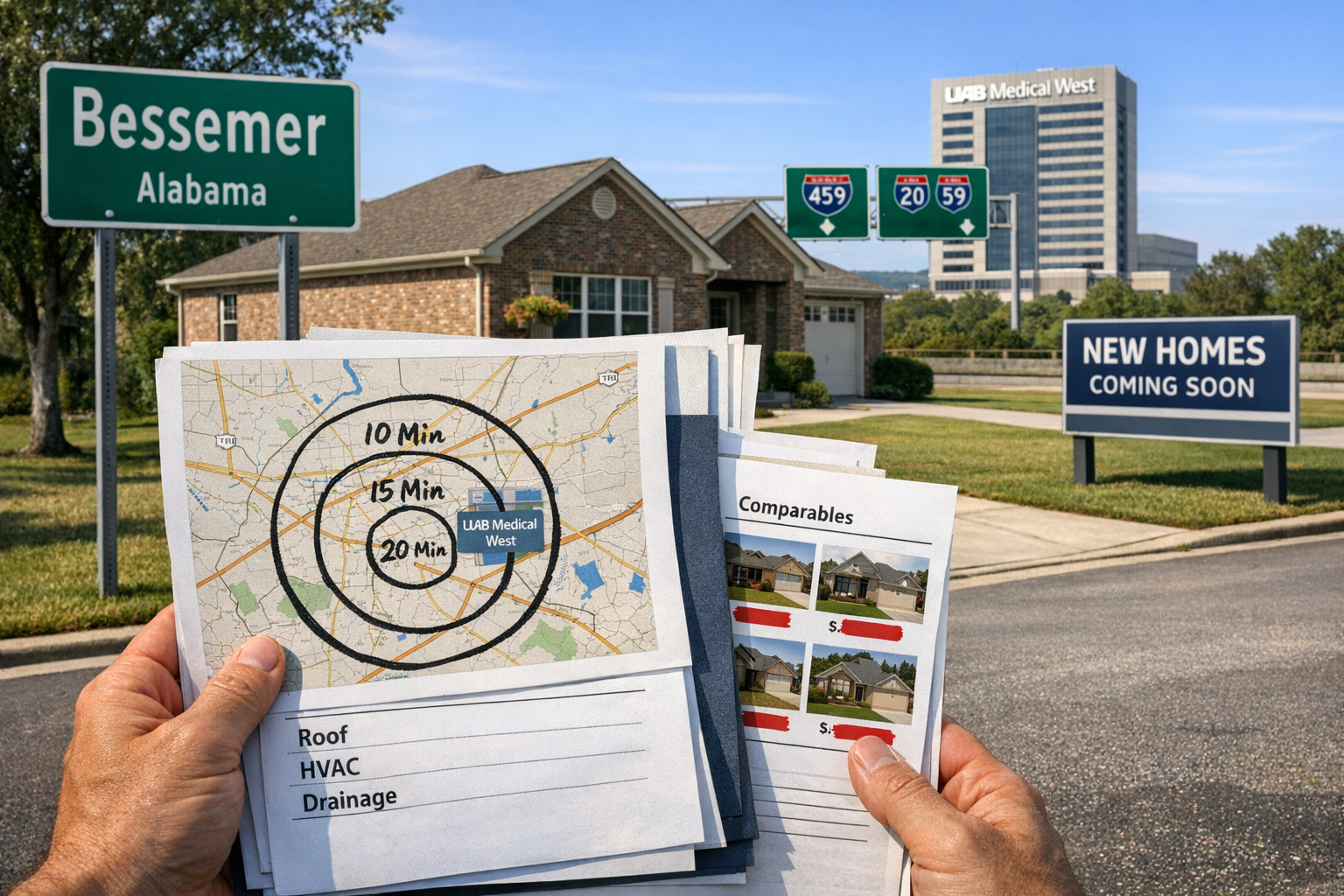
The Healthcare Anchor: Analyzing the Long-Term Equity Impact of the UAB Medical West Expansion for Residential Assets in Bessemer, Alabama
Key Takeaways
- UAB Medical West functions as an institutional anchor that can influence residential equity in the 35022 orbit through steady staffing demand, outpatient traffic, and repeat daily movement tied to the campus.
- Drive-time rings around Medical West offer a practical way to compare neighborhoods in the McCalla–Bessemer corridor, since route certainty to I-459 and I-20/59 can matter more than straight-line distance.
- Appraisal-grade comparable selection in Bessemer requires micro-location matching, housing-era matching, and careful separation of closed sales influenced by subdivision phases from older resale streets closer to downtown.
- Net price tells the real story when seller credits, repairs, and incentives are present, so concessions must be tracked alongside headline sale price to read market movement in Bessemer with accuracy.
- Condition risk and financing friction can shift outcomes quickly in older housing pockets, making roof, electrical, HVAC, drainage, and foundation perception central to equity protection near Medical West.
Introduction: The Professional Pivot in Bessemer, Alabama
A hospital that opens its doors does not behave like a fairground tent raised for a season; it plants itself into the daily life of a place through shift changes, ambulance routes, clinic calendars, and the steady procession of families arriving with worry and leaving with relief. The new UAB Medical West facility opened to patients on Aug. 3, 2024. The roads around such an institution begin to tell their own story at dawn and at dusk, when headlights gather in strings and the clock rules more strictly than any compass. Residential property near that sort of center enters a different conversation, shaped less by passing excitement and more by the habits of working life.
Institutional healthcare works by repetition: staffed units that must be covered, specialized departments that cannot pause, support roles that keep the machine fed and clean and safe, contractors and vendors moving in and out as quietly as the tide. That rhythm can influence housing demand because a person who must arrive before sunrise, stay beyond midnight, or answer a call with little warning tends to measure distance in minutes, not miles. A teaching environment adds its own steady churn through training cycles and specialist services, producing overlapping groups with different timelines and different tolerances for commute uncertainty. Retail corridors, childcare arrangements, and school routines can begin to bend toward that employment gravity, then reflect back into where buyers choose to compete.
This article examines long-term equity impact through evidence that can be checked rather than repeated as gossip: recorded sales, appraisal-grade comparable selection, inventory depth, contract terms that change net price, and rental behavior where leasing data is visible. Drive-time rings serve as the first map, then micro-location realities take over: interchange access, noise, commercial adjacency, and the condition of the home that must satisfy inspectors and insurers. The focus stays on residential assets in Bessemer as they sit under the influence of a major healthcare campus, with attention given to what can strengthen value, what can limit value, and what signals tend to appear when professional households decide that proximity is not a luxury but a practical necessity.
The UAB Medical West Expansion: A New Institutional Center
Campus Presence And Service Reach
The campus operates as a daily conveyor of human need and professional duty, with movement that begins before sunrise and ends after midnight, because illness and care keep no polite calendar. The physical scale signals that constancy through a 412,000-square-foot, nine-story hospital with 200 beds and a 127,000-square-foot medical office building at 5000 Medical West Way, Bessemer, Alabama 35022. Emergency arrivals, inpatient rounds, imaging schedules, surgical check-ins, laboratory draws, pharmacy pickups, visitor hours, supply deliveries, and facilities maintenance create traffic that does not depend on a single department or a single time of day.
A hospital campus of this form draws more than patients who stay the night, because modern care moves along several tracks at once. The emergency department pulls in unpredictable volumes; scheduled procedures create predictable arrival waves; diagnostic imaging and lab services produce steady circulation; rehabilitation and follow-up care bring repeat visits that turn into familiar routes. Each function adds a layer of routine activity that touches roads, fuel stations, nearby stores, and the neighborhoods that sit within an easy drive, because daily life tends to arrange itself around the places that demand reliable arrival.
A modern replacement campus differs from a smaller community hospital through breadth of services, density of operations, and the presence of an attached medical office environment that concentrates outpatient medicine in one address. Community hospitals can provide vital care with a narrower specialist footprint, fewer overlapping service lines, and less frequent involvement from rotating clinical teams, which changes how many different work schedules spill into the surrounding area. A campus designed for multiple specialties and high-throughput diagnostics creates a wider spread of shift start times and appointment blocks, which matters to housing because commute reliability, access routes, and neighborhood convenience become practical concerns rather than abstract preferences.
Teaching Hospital Operations And Staffing Reality
Teaching hospitals carry a dual obligation: patient care must remain continuous, and clinical training must proceed without compromising that care. This structure produces layered staffing, where attending physicians supervise, advanced practice providers extend coverage, nurses and technologists operate the bedside reality, and trainees learn within defined responsibilities while being guided through increasingly complex cases. The building may look still from a distance, yet inside it runs by handoffs, consultations, and coverage plans that require more than one role for the same patient encounter, because teaching medicine is rarely a solitary craft.
Persistent staffing grows out of the work itself, not from mere ambition. Inpatient units require round-the-clock nursing, respiratory therapy, pharmacy coordination, imaging availability, lab turnaround, environmental services, security presence, and administrative support that keeps admissions, discharges, and transfers moving without delay. Surgical services introduce pre-op preparation, operating room teams, anesthesia coverage, post-anesthesia recovery, sterile processing, and post-op monitoring, each function needing trained hands and scheduled redundancy. The result is a workforce that spans clinical, technical, operational, and support roles, with schedules that include days, nights, weekends, and on-call obligations.
Housing search behavior can reflect those patterns without any promise that it must, because households differ and budgets differ. Shift-based work often makes commute time feel heavier than mileage, since an extra ten minutes can become an hour when it steals sleep from a twelve-hour day or complicates childcare pickup after an unexpected delay. On-call roles can elevate the value of route certainty, where highway access, predictable traffic flow, and the ability to return quickly matter as much as neighborhood charm. These pressures do not dictate where a person will live, yet they supply a common logic that shows up in buyer questions, rental inquiries, and the premium placed on convenience when schedules run tight.
Outpatient Care And Medical Office Spillover
Outpatient medicine turns a hospital campus into a place of repeated return, where a single address becomes the scene for consultations, follow-up visits, therapy sessions, imaging appointments, and chronic condition management. A medical office building beside the hospital concentrates specialists, testing, and patient services into a walkable or short-drive loop, increasing the number of arrivals that never become admissions. Clinics and ancillary care create a calendar-driven rhythm of morning check-ins, lunchtime appointment slots, and late-afternoon follow-ups, which sustains steady daytime traffic that complements the unpredictable pull of emergency care.
Specialty care presence widens the employment base and the patient draw because specialists bring their teams, their schedules, and their referral networks. UAB reported the opening of seven specialty clinics at UAB Medical West, listing cardiology, endocrinology, neurosurgery, pain treatment, physical medicine and rehabilitation, pulmonary, and rheumatology among the clinics accepting new patients. Those services tend to involve recurring visits, pre-procedure workups, imaging coordination, and follow-up appointments, which can create repeat patterns of travel and routine consumer activity tied to the same corridors.
Recurring outpatient visits can support nearby retail corridors in a way that is visible on the ground: pharmacies that fill routine prescriptions, quick-service dining that serves families between appointments, grocery stops added to a clinic trip, and service businesses that benefit from steady daytime foot traffic. Patients and families often combine care with errands because time is scarce and travel is costly, which increases the practical value of convenience nodes near the campus. Neighborhood preference can be influenced by that convenience when households weigh school runs, childcare logistics, shopping access, and commute predictability against the demands of medical schedules. The influence is not uniform across every buyer, yet it can be observed through traffic clusters, where services expand, and where everyday life becomes easier to conduct without long detours.
The Hospital Halo Effect: How Proximity Can Translate Into Equity
Drive-Time Boundaries That Guide Buyer Search
Drive-time around UAB Medical West can be drawn with the same practical pencil used by people who must arrive at a specific hour, on the right day, without the mercy of a late start. The campus sits at 5000 Medical West Way in the 35022 ZIP, a placement that makes I-459 the spine of many daily routes and turns Exit 1 into a familiar signpost for anyone traveling between Hoover, McCalla, and the hospital grounds. The hospital’s own posted directions show the path from I-459 Exit 1 onto Eastern Valley Road, then onto Bell Hill Road for the final approach, a sequence that matters because it identifies the chokepoints and turning movements that shape commute reliability more than a straight-line distance ever could.
A drive-time boundary in this part of Jefferson County becomes most useful when tested against the hours that strain a route: early morning when darkness still holds, late afternoon when traffic thickens, weekend mornings when errands crowd the same roads, nights when fatigue shortens patience. The I-20/59 to I-459 connection sits in the travel logic for commuters coming from the Birmingham side, while the I-459 corridor gathers traffic from the Hoover direction and the broader south and east arcs. The same neighborhood can feel “near” on a calm Sunday yet feel distant on a weekday when a single slowdown on the wrong segment turns punctuality into a gamble.
“Close to work” and “close to access routes” separate into different virtues around the Medical West site because the last mile is not the same for every address. A home that sits a little farther yet reaches I-459 quickly can compete with a home that sits nearer while forcing the driver through slower local corridors, more signals, or a route with fewer options when a wreck blocks the way. Search behavior often reflects this reality in quiet ways, with buyers asking about interchange access, turn restrictions, and alternate paths that still arrive at the same Bell Hill Road approach without detours that stretch a shift change into a scramble.
Equity Timing After a Major Opening
Housing decisions tied to a new hospital campus often lag behind the ribbon-cutting because routines take time to become real in the bones. Job offers get accepted, credentials get processed, schedules reveal their true shape, and the household learns whether the workday ends on time or leaks into the evening with a chart that must be finished and a call that arrives late. Temporary living arrangements can bridge that learning period, which means the first wave of staffing does not always match the first wave of home purchases.
Testing for delayed moves in Bessemer works best when the market is sliced into small, comparable pieces rather than treated as a single stew. The hospital address in 35022 invites a ring-based approach: compare 35022 sales behavior against other Bessemer ZIP codes that share the same metro gravity but sit farther from I-459 Exit 1. January 2026 data on Redfin shows the city-wide Bessemer median sale price at $215,000 with an average 106 days on market, a snapshot that can serve as one baseline for timing and turnover when compared against nearer submarkets.
Signals worth watching in that test are not mysterious, though they demand discipline: turnover in the drive-time ring, list-to-close speed, the share of listings that need price cuts, and the amount of competing supply introduced by new construction phases or a sudden surge of resale listings. January 2026 data on Redfin shows the 35022 median sale price near $309,900 with an average 92 days on market, a data point that can be contrasted against the city-wide figures without claiming a single cause for the difference. The method stays honest when it separates “what happened” from “why it happened,” then checks the same measures across several months so one lively season does not pretend to be a permanent condition.
Demand Floors and Volatility Behavior
A demand floor near a major healthcare campus is measured by how the market behaves when it is denied easy optimism, when rates shift, when inventory rises, when a broader region cools. The most useful comparison is not a single median price but the pattern of movement: how far prices swing, how often listings sit, how frequently sellers concede through credits or repairs, how steadily the neighborhood produces qualified buyers when the first rush has passed. A practical method sets a near-hospital group of comparable homes inside the 35022 drive-time ring, then matches it to similar homes outside that ring by age band, square footage range, and condition tier, so the comparison is not corrupted by mixing new builds with older stock or renovated homes with deferred-maintenance properties.
Volatility becomes visible when the same measures are tracked in a rolling window: median and average sale prices together, days on market, sale-to-list ratios, the count of active listings, the count of pending listings, and the number of price reductions per month. A second lens comes from the “spread” inside a month, looking at how far the top quartile runs from the middle and how far the lower quartile falls, because a widening spread can signal that only the most updated homes are drawing bids while ordinary homes drift. The approach stays rooted in verifiable records, with closed sales treated as the final word and list prices treated as mere intention.
Conditions that weaken the halo effect in this corridor show themselves in plain mechanics: oversupply that gives buyers too many choices, access that becomes inconsistent, and micro-location burdens that eat away at daily convenience. Oversupply can arrive through phased subdivision releases that stack multiple similar homes against each other, or through a swell of existing-home listings when owners decide to test the market at once, each scenario changing negotiation leverage without requiring any change in employment. Access can weaken when the route to I-459 Exit 1 becomes slow at the same hours hospital staff travel, when construction reroutes traffic, when the last-mile roads carry more volume than their design tolerates. Micro-location burdens can include noise from heavy traffic, awkward turns, poor lighting on approach streets, or commercial adjacency that makes evenings feel restless, each factor capable of shifting demand a mile down the road even when the hospital remains in the same place.
Household Demand Shifts Tied to Clinical Payrolls
Buyer Profiles And Housing Selection Patterns
Clinical payrolls bring households that live by different clocks into the same set of neighborhoods, and the differences show up first in how a home must behave at odd hours. Physicians and surgeons can carry clinic days that look ordinary on paper, then find the calendar broken by call, consults, and cases that do not keep tidy hours. Advanced practice providers often sit in the seam between inpatient and outpatient care, keeping continuity that can stretch a workday past the last appointment. Nurses, technologists, imaging staff, respiratory therapists, lab personnel, and pharmacy teams tend to work within strict handoffs, where arrival time is not a courtesy but a requirement, while administrators and department leaders may keep steadier hours yet remain bound to staffing needs and operational incidents that arrive without invitation.
Home selection near Medical West commonly turns on practical protections that preserve sleep and reduce friction, since fatigue makes small annoyances feel heavy. Split-bedroom layouts, bedrooms set away from street-facing windows, and interior hallways that soften sound can matter when one person sleeps through daylight while another moves through a normal household rhythm. Garages and mudrooms carry more weight when uniforms, equipment bags, and work shoes need a place that does not trespass into bedrooms, and when a late return should not wake the whole house with doors and footsteps. Privacy needs can rise with schedule intensity, which can elevate interest in fenced yards, deeper setbacks, and lots with fewer sight-lines from neighbors, without turning the search into a hunt for luxury.
Commute tolerance in western Jefferson County often separates into two decisions that sound similar yet behave differently: distance to the hospital in calm traffic, and predictability when roads behave badly. A household that works nights may accept a few extra minutes if the route is consistent and the home is quieter, while a household tied to early starts may choose the more direct path even if the neighborhood feels busier. Budget and inventory steer the outcome, not sentiment, and recent market snapshots for the 35022 ZIP show the sort of pricing and rental levels that shape what different hospital-linked households can realistically pursue.
Lifestyle Logistics That Affect Neighborhood Choice
Early departures and late arrivals turn a house into a place of thresholds: the driveway, the front walk, the porch light, the first lock, the last lock, all repeated in darkness while the rest of the street sleeps. Overnight shifts raise the value of quiet streets and calm corners, since daytime traffic noise can cut rest into scraps, and a route that feels harmless at noon can feel tense when a tired person returns near dawn. Lighting becomes a practical matter rather than a decorative one, because visibility at the curb and at the entry reduces the chance of missteps, lost keys, and unwanted encounters. Sound carries differently at night, and the clatter of bins, barking dogs, and a neighbor’s stereo can feel louder when the body is trying to recover from a long shift.
Parking shows its influence in small humiliations that repeat until they shape a decision. Tight streets and limited curb space can turn a simple arrival into a maneuver, then into an argument, while wider driveways and garages allow the household to move in and out without bargaining for space. Guests visiting after a procedure, relatives arriving for support, and friends dropping off meals can stress a street with scarce parking, so households often notice whether visitors can stop without blocking traffic or stepping into poor lighting. Low-maintenance exteriors rise in importance when the week has little room for repair projects, and when deferred upkeep threatens inspections, insurance questions, and surprise expenses that land at the worst times.
Day-to-day friction in the Medical West orbit often comes from sequences rather than single errands: a shift change followed by school pickup, a late discharge followed by a grocery run, a night shift followed by a morning appointment that cannot be moved. Neighborhood choice can lean toward places that shorten those sequences, where roads connect cleanly to the corridors that hold daily necessities. A household that has lived one month under a new schedule can make different choices than a household that has lived six months under it, and the homes that look appealing on a weekend tour can feel less appealing after the first week of pre-dawn alarms and late-night returns. The pattern is not romance; it is routine, repeated until it becomes the household’s measure of what is livable.
Amenities That Follow Stable Employment
Stable healthcare employment can support steady retail and service demand in the places where people already travel, and the effect can be felt where errands cluster along common routes. Pharmacies, quick meals, groceries, childcare, and fitness stops tend to attach themselves to the same corridors used for commutes because time remains scarce and repetition remains efficient. Downtown provides a separate draw that does not depend on the hospital corridor, offering walkable civic space and events that give households a place to step outside the workday without a long drive. DeBardeleben Park sits in the heart of downtown and is used for community gatherings and recurring events, which becomes part of the lifestyle calculus for households comparing neighborhoods across the city.
Recreation and public-space investment can matter to clinical households because recovery from stress requires places that are easy to reach and safe to use at ordinary hours. The City of Bessemer describes an ongoing rails-to-trails project with completed phases running along 14th Street/Highway 150 from Fairfax Avenue to Carolina Avenue, with planned continuation into downtown toward the Hall of History. That sort of corridor can influence neighborhood preference when it offers a predictable place for walking and cycling that fits into a schedule squeezed by long shifts. Homes near parks and trail connections can draw attention from households that want movement and fresh air without turning exercise into another commute.
Historic downtown carries its own appeal for households that value proximity to civic life, dining, and the texture of older streetscapes, while newer residential pockets closer to the hospital corridor may appeal to households that want newer systems, easier parking, and less maintenance. The Downtown Bessemer National Historic District is promoted by Alabama’s official travel site as a place tied to the city’s boomtown history and the coal, iron, and rail era, a fact that frames why the streets and building patterns feel different from suburban subdivisions. Choices across these areas often come down to daily tradeoffs that can be seen and measured: time, noise, access, upkeep, and the kind of neighborhood life that feels possible when the workday runs long.
Submarket Spotlight: The McCalla–Bessemer Corridor
Drive-Time Rings And Practical Boundaries
Drive-time rings in the McCalla–Bessemer corridor earn their keep only when drawn from the roads that people must use, at the hours they must use them, with a notebook that does not forgive wishful thinking. Straight-line distance can flatter an address that sits “near” the hospital on a map while hiding the minutes lost to two-lane segments, school traffic, or the wrong sequence of signals. A workable framework begins with three time bands measured from the driveway to the hospital campus, then repeats the same runs across a weekday morning, a weekday evening, and a weekend midday to see whether a route stays steady or turns fickle when the county is awake.
Weekday shift travel in this corridor carries a different temper than weekend movement because the same interstates and connectors serve industry, schools, errands, worship, and recreation, each claiming its own slice of the clock. Weekend patterns can pull households toward leisure and dining destinations that are named again and again in local community descriptions, which reveals where discretionary trips tend to point even when work is silent. Community information for Willow Trace highlights proximity to Tannehill Ironworks Historical State Park and Historic Downtown Bessemer dining as nearby favorites, showing the direction of common non-work trips from that pocket of 35111.
Ring-building stays honest when it separates “fastest route” from “most reliable route,” then notes which neighborhoods have more than one viable path when trouble appears. Reliability matters in this corridor because a single disruption can push traffic onto the same handful of alternatives, and those alternatives do not carry equal capacity or equal calm. Notes taken during repeated runs can be matched against active listing clusters by ZIP and subdivision, which allows buyers and sellers to judge whether a premium for one pocket is being paid for square footage alone or for time certainty that holds through the week.
Community Snapshots Near The Corridor
Willow Trace reads like the newer page of the McCalla–Bessemer story, where the homes arrive in a consistent modern language and the ranges in size invite more than one kind of household into the same streets. The plans run from 1,497 to 2,511 square feet, a spread that matters in practice because it allows a buyer comparing a three-bedroom single level against a five-bedroom two story to stay inside one neighborhood while still changing the living pattern entirely. Life outside the front door points toward familiar western Jefferson County landmarks, with community materials tying the neighborhood to Frank House Golf Course, Tannehill Ironworks Historical State Park, The Bright Star, and the restaurants of Historic Downtown Bessemer, which helps explain why weekend traffic from this pocket often aims in those directions. Comparable sales work here lives or dies by matching the plan family and the build stage, since a larger layout closing beside a smaller one can create a price spread that looks like momentum until the square footage and features are laid side by side in plain daylight.
Heritage Crest carries a cottage-style profile that sits differently on the land and asks different questions of a buyer, since the feel of the street and the space between homes becomes part of what gets purchased. The home sizes are presented from 1,281 to 2,164 square feet, which places many choices in a band where layout efficiency, storage, and daily flow can outweigh raw size in how the house performs under a demanding schedule. The neighborhood comparison in this pocket benefits from attention to what can be seen during an ordinary visit: where bedroom windows face, how porches and entries sit toward the street, how driveways handle two vehicles without blocking movement, how outdoor space functions when it is used rather than admired. A clean evaluation sets Heritage Crest against a nearby product that competes for the same buyer, then weighs whether the cottage format delivers quieter rest, lower upkeep, or easier daily movement than a larger home in a different street pattern.
Crosswinds at Cedar Creek sits closer to the hospital’s ZIP geography and carries a wider spread of plan types, offering ranch and two-story options that start at 1,164 square feet and run to 2,565 square feet. The corridor position matters because it draws attention from households living by different commutes: some tied to UAB Medical West, some tied to Hoover-facing routes, some moving between McCalla, Bessemer, and the larger Birmingham orbit as the week demands. The floor-plan variety can widen the buyer pool, yet it also demands sharper comparable selection, since a small single-story closing and a large two-story closing may share a neighborhood name while living in different price brackets with different competitive sets. Lot placement and entrance proximity carry weight here because the daily route out of the neighborhood decides whether the morning begins with a smooth merge or a series of small delays that repeat until they shape what a household calls “near.”
Access Nodes That Support Consistent Demand
Access nodes in the McCalla–Bessemer corridor do not live in abstraction, since I-459 and I-59/20 form the working frame for commutes that must hold together at dawn, at dusk, and in the dark hours when a late arrival costs more than pride. The beltway connection can shorten travel to the hospital area from Hoover-facing pockets, while the I-59/20 corridor gathers movement toward Tuscaloosa on one side and Birmingham on the other, which makes the junctions and ramps more than concrete; they become a daily wager on time. Neighborhood demand can tilt toward whichever side of the corridor offers fewer “single points of failure,” where one crash or one closure forces every driver into the same narrow chute.
Choke points and construction zones can redirect that tilt without changing anything about the houses themselves, and the present DDI work at McAshan Drive shows how quickly that redirection can happen. ALDOT reported that bridge girder installation for the McAshan Drive diverging diamond interchange project would require rolling roadblocks on I-59/20 between I-459 and Exit 104 during overnight work windows. A buyer comparing two neighborhoods five minutes apart in calm traffic may see them differently when one route regularly encounters lane shifts, overnight restrictions, or congestion caused by detours.
Time certainty for hospital staff can depend on how many alternate paths exist when the main route sours, and the corridor offers uneven options depending on the pocket. Some areas allow a quick pivot between interstate access and local connectors, while others funnel traffic onto the same ramps and the same intersections, making congestion feel personal because it repeats with a cruel familiarity. Demand often follows the addresses that keep their promises during construction seasons and heavy-traffic months, since reliability becomes a form of comfort that can be priced into what buyers are willing to pay and what sellers can reasonably expect.
Residential Inventory Positioned for Hospital-Driven Demand
Newer Construction Versus Established Neighborhood Stock
A walk from the brick storefronts and older blocks near the Downtown Bessemer Historic District into the newer subdivisions along the McCalla–Bessemer edge feels like stepping between chapters written in different centuries, since the district’s period of significance spans 1887 to 1941 and carries the built imprint of that era. Newer construction in the 35022 and 35111 orbit often arrives with recent systems, standardized materials, and a builder’s sequence of trades, while established neighborhoods closer to downtown and the older corridors can carry repairs layered over decades, with additions, remodels, and patched solutions that tell their story in the attic and crawlspace. Inspection outcomes can diverge across those age bands because older construction can include older wiring approaches, older plumbing materials, and foundations that have settled into their own long-standing habits, while newer homes more often present modern panels, modern fixtures, and uniform framing that reads cleanly to an inspector’s eye.
Maintenance expectations in these two worlds tend to show up first in the roofline and the mechanical systems, because the Alabama sun, storms, and humidity show little patience for deferred care, and a hospital schedule leaves little room for surprise repairs. Newer homes can carry fewer immediate projects, while older homes can require a tighter reading of what has been updated, what was updated without permits, and what remains original behind fresh paint. Insurance friction can increase when a home presents older roofs, older electrical panels, or visible water history, and the state’s broader focus on roof resilience shows up in programs tied to wind mitigation for existing owner-occupied homes, a signal that insurers and regulators are paying close attention to roof performance.
Updates translate into value only when they fit the price ceiling of the surrounding market, since a renovation that cannot be bracketed by nearby closed sales risks becoming a private expense rather than a supported value adjustment. Zillow’s Home Value Index for ZIP 35022 shows a typical home value of $274,155 with data through January 31, 2026, a reference point that frames what the surrounding market has been paying for the general housing mix in that area. U.S. Census Bureau QuickFacts reports a median value of owner-occupied housing units of $135,900 for Bessemer city (2020–2024), a separate lens that reflects how much of the city’s inventory still trades in a different value band than the newer corridor product. A renovated kitchen in an older pocket can add appeal and reduce days on market, yet the appraisal support still comes from what similar homes have actually sold for nearby, not from the beauty of the work alone.
Floor Plans That Fit Hospital Households
A corridor shaped by a major hospital does not reward floor plans only for their show; it rewards the plans that allow a household to live out-of-sync without living at war. Homes in the newer subdivisions near the Medical West orbit tend to offer open living spaces that make a smaller footprint feel usable, while many older Bessemer homes carry separate rooms and narrower halls that can make quiet easier to protect when one person sleeps and another moves about. A shift-based household can lean toward separation between the primary sleeping area and the loudest parts of the home, whether that separation comes from a split-bedroom plan, a hallway buffer, or a second-floor sleeping zone that keeps rest above the day’s noise.
Bedroom count often matters less than how the extra space behaves, since a “fourth bedroom” can become a daylight sleep room, a charting nook, a study, a nursery, or a guest room for family arriving during a medical event. Flex spaces, lofts, dining rooms that function as offices, and dens that can close off from the kitchen can serve households tied to on-call life, where a call might arrive during dinner and privacy becomes urgent. The corridor inventory offers both ranch and two-story options, and the choice can carry practical consequences, since stairs can feel longer after a long shift and a two-story layout can offer the separation that daytime rest requires.
Storage and laundry placement turn into daily facts in a household that changes clothes for work, keeps uniforms clean, and returns home with bags, badges, and the weight of the day. Laundry near bedrooms can shorten the weekly grind, while laundry near the garage can keep work clothing from drifting through living spaces, and both patterns appear across Bessemer’s mixed inventory. Noise buffers can come from simple design choices: interior bedrooms, insulated garage walls, solid-core doors, and landscaping that reduces street sound, features that can matter more in a close-set neighborhood where sound travels from driveway to window in a straight line. None of these elements rule every decision, yet each one can decide whether a home feels workable when the household lives by a schedule that changes without apology.
Renovation Choices That Hold Up In Valuation
Valuation in Bessemer moves by evidence, and evidence arrives in the form of closed sales that share the same micro-market, the same era, and the same livability profile. A renovation that holds up in an appraisal is one that can be bracketed by what nearby buyers have already paid for, and that bracketing becomes more precise inside neighborhoods where homes repeat their form and less precise where every house tells a different story. The McCalla–Bessemer corridor subdivisions make bracketing easier because the plans are often similar, while older areas closer to downtown can require tighter micro-matching because the differences between two homes on the same street can be larger than the differences between two homes a mile apart.
Improvements tied to function and condition tend to survive scrutiny because they reduce risk that a buyer can see and a lender can measure. Roof age, HVAC performance, safe electrical service, sound plumbing, drainage that keeps water away from the foundation, and crawlspaces that stay dry can matter in older Bessemer pockets where time has had decades to test each system. Cosmetic changes can create a faster sale when the market is choosing between similar listings, yet the value support still depends on whether nearby closed sales show buyers paying more for the same cosmetic level within the same neighborhood ceiling.
Upgrades that fail to return value in similar neighborhoods often share one flaw: the improvement is too unique for the street, too expensive for the ceiling, or too disconnected from what local buyers can finance and appraisers can justify. Luxury finishes can outpace neighborhood pricing bands, oversized additions can introduce functional issues in the yard and parking, and highly personalized design choices can narrow the buyer pool in a market that needs depth to support strong resale. Bessemer’s split inventory between older established neighborhoods and newer corridor subdivisions makes this risk easy to spot when the work is compared to nearby closed sales, since the same dollar spent can be supported in one pocket and ignored in another, not out of cruelty, but out of market arithmetic.
Rental Demand Near A Major Hospital Without Speculation
Tenant Mix And Leasing Patterns
Hospital-driven leasing in the Medical West orbit shows itself most clearly when the tenant pool is treated as a set of identifiable lanes, each lane leaving different footprints in lease length, furnishing level, and move-in timing. Cohorts tied to clinical training can be documented, since Medical West appears as a Bessemer affiliate site in the University of Alabama at Birmingham School of Health Professions clinical education placements for Medical Laboratory Science. A separate lane can be traced through graduate medical education partnerships that place early-career physicians in the city, since a UAB Family and Community Medicine announcement describes a PGY-1 year at Cahaba Medical Care in collaboration with UAB Medical West in Bessemer.
Rotations and specialty training add another measurable layer because they create time-bound presence that can be tracked through leasing records, furnished inventory, and the timing of shorter renewals. UAB Physical Medicine and Rehabilitation’s Interventional Spine & Musculoskeletal Medicine Fellowship lists UAB Medical West as one of its primary sites, linking the campus to an ongoing schedule of fellows and supervising clinicians moving between locations. Travel clinicians, new hires, vendor representatives, and support staff can be separated from trainees by the paper trail of move-in documentation and typical lease terms, a step that replaces rumor with categories that can be counted over time.
Seasonality in this part of Jefferson County can be tested against the calendar that governs family life, since the Bessemer City School System calendar sets dates that often correlate with moves, unit turnover, and mid-year transfers, including Winter Holiday Break (Dec 22–Jan 2) and Spring Break (Mar 23–27) for the 2025–2026 school year. Leasing cycles can then be compared with hospital onboarding waves by watching when application volume rises, when lease start dates cluster, and when furnished listings become scarce, all within the 35022–35020–35023 geography that renters use as a practical map rather than a civic boundary.
Rent-Ready Standards That Attract Medical Tenants
Rent-ready in the Medical West corridor is less about ornament and more about a home that behaves well at odd hours, since many tenants tied to healthcare arrive tired, leave early, and expect the property to operate without small failures that turn into daily punishment. Cleanliness must extend past what a showing reveals, reaching HVAC returns, filters, appliance interiors, and bath ventilation, because a home that smells stale or holds moisture tends to draw faster complaints and faster turnover. Lighting takes on unusual weight in neighborhoods where departures happen before dawn and returns land after dark, making a well-lit entry, clear walkway, and functional exterior fixtures part of the lived experience rather than mere curb appeal.
Safety features and maintenance friction belong to the same practical ledger, since a tenant rushing toward a shift has little patience for sticky locks, unreliable smoke alarms, loose rails, tripping hazards, or a water heater that behaves like an unpredictable relative. Appliance reliability matters in Bessemer’s mixed inventory because older housing pockets can hide aging systems behind cosmetic updates, while newer corridor homes can still suffer early failures from heavy use and builder-grade components. Low-friction maintenance starts with simple repeatable practices: documented service vendors, clear response windows, scheduled preventative work, and a repair log that keeps recurring problems from returning like bad dreams.
Neighborhood norms in Bessemer set the boundaries for what improvements earn their keep, since a property in the older 35020 core competes against a different rent band than a newer 35022 corridor home, and the rent-ready standard must match the rent asked. Realtor.com’s December 2025 reporting period shows a citywide median rent of $1,837 with 70 active rental listings, then separates the city into rent bands that include 35022 at $2,032 (26 rentals), 35020 at $1,072 (31 rentals), and 35023 at $1,260 (13 rentals). A landlord who aligns condition, lighting, and maintenance reliability to the rent band in that specific ZIP avoids the common Bessemer mistake of spending like a luxury corridor while charging like an older core, a mismatch that invites vacancy even when the hospital anchor remains strong.
Exit Paths For Long-Hold Ownership
Exit strategy near UAB Medical West changes the moment the likely buyer is named, because the buyer determines what gets paid for and what gets dismissed as decoration. Owner-occupant resale in the 35022 corridor often leans on daily livability tied to the hospital commute, where a quiet sleeping wing, predictable parking, a low-friction route to I-459, and a home that feels calm after a long shift can matter as much as square footage. Investor resale in the older 35020 core and the mixed 35023 pocket often reads the same house as an income tool first, then asks whether the property can carry predictable rent, predictable repairs, and predictable vacancy in that specific ZIP band without drifting into constant maintenance.
Positioning for owner-occupants tends to reward clarity and confidence during showings, since many hospital-linked households shop under time pressure and reject homes that hint at hidden work. Mechanical stability becomes part of the story in older Bessemer stock where systems may be near the end of service life, and cosmetic polish only carries weight when it sits on top of sound roofing, dry crawlspaces, reliable HVAC, safe electrical service, and drainage that behaves after heavy rain. Positioning for investors favors evidence over charm: rent history where available, consistent turnover practices, and a condition level that matches what competing rentals in that same submarket offer, since a “premium” finish rarely earns a premium buyer when the rent ceiling for the surrounding streets refuses to rise with it.
Documentation determines how smoothly underwriting and appraisal move, and the need is sharper in Bessemer where older homes, mixed renovations, and uneven contractor work can raise questions that delay closings. A long-hold owner preparing an exit can build a file that reads like a timeline: dated invoices for roof, HVAC, plumbing, electrical, and drainage work; permit records when permits exist; warranty transfers; service logs; appliance installation dates; photos taken before walls were closed; and a written scope summary that explains what was repaired and why. Appraisal support strengthens when that file is paired with a simple list of improvements that can be compared against nearby closed sales of similar homes, since the goal is not to impress with cost but to prove condition and function in a way the market can recognize.
Market Friction and Constraints That Still Shape Outcomes
Inventory Surges, Builder Activity, and Price Compression Risk
New supply in the McCalla–Bessemer corridor can arrive in waves that feel orderly to a builder and unruly to a price graph, because a “phase” releases multiple similar roofs into the same buyer pool at nearly the same time. A pocket near Medical West can carry strong day-to-day demand, then show price compression when choices multiply, concessions creep in, and buyers stop fearing scarcity for a season. That compression tends to show first in the most interchangeable inventory, where similar square footage and similar finishes leave little room for one listing to claim a premium without proof.
Monitoring builder activity around the city limits becomes practical when permit paper trails are treated as early signals rather than after-the-fact trivia. City-issued building activity can be tracked through Inspection Services permitting, since the City of Bessemer maintains a building permit application process under the Inspection Services Department. McCalla-side construction outside municipal boundaries can follow a separate path through Jefferson County permitting in unincorporated areas, making jurisdiction lines more than politics when a buyer is trying to predict how many similar homes will compete next quarter.
Active-to-pending ratios give a sober reading when tracked inside the same micro-area instead of across all of Jefferson County, since corridor neighborhoods can behave differently from older streets nearer downtown. A clean method keeps one tally for newly built listings in the same phase and another tally for established resales competing for the same buyers, then watches how quickly pendings replace actives after each new release. Inventory changes driven by existing homeowners listing can also shape this ratio, and statewide reporting from Alabama REALTORS has discussed rising inventory while noting a decline in new building permits between 2024 and 2025, a context that helps separate “more listings” from “more new construction” when reading corridor shifts.
Insurance, Property Condition, and Inspection Sensitivity
Financing friction in older Bessemer housing stock often begins with the parts of a home that refuse to be charmed: roof age, electrical capacity and safety, HVAC reliability, drainage behavior, and the way a foundation reads to an inspector who has seen too many surprises. Neighborhoods closer to the older core can carry renovations layered across decades, with one owner updating a kitchen while another postponed the crawlspace work that keeps moisture from returning. The result can be a home that shows well in photos yet triggers lender and insurer questions once reports and quotes arrive, especially when the property’s visible condition suggests deferred maintenance behind cosmetic improvements.
Condition issues can widen the gap between list price and net sale price through a chain of ordinary events: an inspection report lists repair items, contractor estimates arrive, insurers request roof documentation, lenders demand repairs or credits, the buyer asks for concessions, the seller chooses between price reduction and repair work. A corridor home built in recent years may still face this gap when grading and drainage were handled poorly in the rush of construction, while an older home may face it when systems are near end of life and replacement costs do not match what the street will support. Net price is shaped by credits, repairs, and time, and those costs can be larger in older pockets where the scope of work touches multiple trades at once.
Inspection sensitivity can be managed without pretending the process is gentle, since the most effective work is the work that removes uncertainty before the first offer arrives. A seller preparing an older home near downtown can gather roof records, HVAC service history, electrical updates, and drainage corrections in a single file, then pair that file with receipts that show dates and contractors rather than vague claims. A buyer comparing homes across 35020, 35022, and 35023 can treat inspection outcomes as part of valuation, since a lower list price can be overtaken by repair costs that arrive after contract when the home’s systems tell the truth.
Access, Noise, and Externalities
Highways and freight corridors can reward one street and punish the next, since access that looks convenient by day can sound relentless by night, and a shortcut can become a funnel when traffic thickens. I-459 and I-20/59 shape the corridor’s time certainty, and those routes sit within the Interstate network that the federal government includes on freight routing maps, a reminder that trucks share the pavement and bring their own rhythms of volume and noise. Commercial adjacency can also redirect demand inside the same ZIP, since a home near a late-night operation, a heavy-traffic arterial, or a cluster of loading activity can lose appeal even when it sits close to the hospital.
Evaluating nuisance risk benefits from site visits staged like a schedule, not like a sightseeing trip, since the corridor behaves differently at each hour. Morning visits reveal school traffic and commuting queues, afternoon visits reveal signal timing and turning delays, night visits reveal lighting gaps, road noise, and how safe the approach feels when the street is quiet. A route that seems smooth at midday can become unreliable when a crash shuts down a lane or when roadwork shifts traffic, and statewide live traffic tools can help confirm whether a slowdown is a one-day event or a recurring pattern.
Construction zones and choke points can redirect demand between neighborhoods without changing a single countertop, since buyers tend to avoid routes that routinely trap them at the same ramp or the same interchange. Traffic patterns can be studied with ALDOT’s public traffic data mapping, which allows searches by location and year, offering a way to pair local observation with reported traffic counts when evaluating the burden carried by a corridor street. A buyer comparing two similar homes five minutes apart can treat access and noise as valuation inputs in this market, since time certainty often decides whether “near Medical West” feels like a benefit or a burden once the workweek begins.
Appraisal-Grade Due Diligence For Equity Protection
Comparable Selection When A Submarket Is Moving
Comparable selection around UAB Medical West begins with a simple refusal to let a citywide label blur the street-level truth, since the buyer pool for a newer 35022 corridor roof does not always behave like the buyer pool for an older 35020 block near downtown. Recent closed sales carry the most weight, yet “recent” must be paired with “similar,” because a fast-closing new-build model in a staged subdivision can mislead when compared to an older home with mixed renovations and decades of wear. Jefferson County’s Citizen Access portal provides parcel-level detail that helps verify what a listing description can exaggerate or omit, including land and building details, valuation, deed information, and map links.
Similarity bands in this market need to be built like fence rails, tight enough to hold the comparison upright, wide enough to capture enough sales to be credible. One band fits the corridor subdivisions where plans repeat and the market often prices by model and finish level; another band fits the older neighborhoods where every house tells a different story and condition swings can be wider than square footage swings. Micro-location matching deserves its own seat at the table, since two homes with identical interiors can trade differently when one sits closer to the I-459 travel logic that hospital staff depend on and the other sits behind slower local routes that behave badly at shift-change hours. A moving submarket reveals itself when similar homes close at noticeably different terms within short windows, so the most useful comps are the ones that share not only size and age, but the same daily travel reality.
Search radius should expand like a cautious step into dark water, not like a leap. Expansion makes sense when the immediate pocket produces too few closed sales, when the subject property is unusually large or unusually small for its street, or when the home sits on acreage that has no true twin nearby. Tightening makes sense when the neighborhood has enough repeats to support it, when subdivision phases are closing in clusters, or when a single mile changes access so sharply that the buyer pool changes with it. Corridor analysis often works best when the radius is adjusted along the direction buyers actually travel, since a comp that is farther away yet shares the same route spine can be more faithful than a comp that is closer but lives behind a different set of bottlenecks.
Concessions, Repairs, And True Net Price
Headline price can flatter a market that is quietly negotiating, so due diligence in this city must separate what was advertised from what was truly paid. Net price is shaped by seller credits, repair agreements, allowances, and any other term that shifts cost from buyer to seller without changing the number printed in bold. Recorded documents can help confirm the bones of a transaction, since Jefferson County’s Landmark Web service provides access to land records and public record filings, and it reflects the county’s division between Birmingham and Bessemer offices.
Repair-driven price distortion in older pockets often arrives through the same familiar characters: roof life, HVAC reliability, drainage behavior after heavy rain, electrical service that raises lender eyebrows, crawlspace conditions that smell of moisture, foundations that look sound to a casual visitor yet worry an inspector. The gap between list price and net price can widen when those issues surface late, because the cure becomes a negotiation of credits, contractor scope, timelines, and risk tolerance rather than a neat reduction on paper. Tracking the distortion requires a ledger built from actual contract terms, not from assumptions, with each comparable marked by whether repairs were completed, credits were given, or price was reduced to cover the work.
Contract terms that distort apparent movement can be tracked without guessing by keeping a consistent worksheet for every comparable: original list price, final list price, closed price, known credits, known repairs, and any disclosed incentive that affects buyer cost. A pattern of rising closed prices can look like acceleration while net outcomes are flat once credits are counted, and a pattern of stable closed prices can hide softening when repairs and allowances are climbing. Market reading becomes more reliable when the same method is applied to corridor new construction and to older resales, since the “incentive language” differs even when the financial effect is the same. The goal is not to punish a market for negotiating, it is to measure it honestly so equity decisions rest on what was paid, not what was promised.
Data Sources That Support Verifiable Conclusions
Verifiable conclusions in this city come from sources that leave a paper trail and can be checked by any careful reader with patience. Official hospital information belongs in that stack because it anchors the discussion to what was built and what is operating, while local planning documents belong beside it because residential supply is shaped long before the first “For Sale” sign appears. A subdivision’s direction can be traced through platting and development paperwork, and the City of Bessemer’s application for preliminary or final plat shows the kind of document trail that signals how new neighborhoods move from concept to lots.
MLS trend data and major housing portals can support timing and context, yet they must be treated as lenses rather than verdicts, since each platform has its own capture methods and its own blind spots. Regional market reporting adds another layer when it is tied to the same county and the same professional data sources used by local brokers, since it can help separate a Bessemer micro-move from a broader Jefferson County drift. The Birmingham Association of REALTORS publishes market updates for the Central Alabama market that includes Jefferson County, providing a recurring reference for inventory and sales conditions that sit around this city like weather around a house.
Standards for publishable fact versus analysis keep the work honest and keep the reader protected from dressed-up guesses. Publishable fact includes recorded deed dates and recorded document images, permit and plat filings, publicly posted hospital details, and published market reports with clear definitions. Analysis includes any statement that links the hospital expansion to price behavior, leasing behavior, or buyer demographics, since that link must be tested against sales patterns and contract terms rather than declared as destiny. Conclusions that respect this line can still be strong, since the strength comes from the chain of evidence, not from the heat of the language.
Working With LAS Companies of KW Hoover
Valuation Experience Applied to Residential Decision-Making
Valuation-oriented work at LAS Companies of KW Hoover starts where many buyers and sellers get into trouble: treating “near UAB Medical West” as a single promise, when the corridor breaks into small pockets that behave differently in price, days-on-market, and inspection outcomes. An appraisal-grounded lens shapes how closed sales get selected, how condition gets weighed, and how a number earns the right to be trusted when inventory shifts between older streets and newer subdivision phases. A valuation and appraisal background sits behind the approach used by LAS Companies of KW Hoover.
Pricing strategy becomes sturdier when it is built from bracketing rather than hope, with each comparable chosen for the same drive-time logic, the same housing era, and the same livability profile that buyers can feel within minutes of stepping inside. Offer strength follows the same discipline: risk control comes from knowing where the market is firm, where concessions hide in contract terms, and where a “high” price becomes fragile because the condition or the location cannot be supported by nearby closed evidence. Repair sensitivity in older Bessemer pockets and incentive behavior in new construction require different reading, so the valuation workflow separates those worlds instead of blending them into one average that comforts nobody at the closing table.
A micro-market process near Medical West works best when it is treated like a map drawn by feet and tires, not by a straight ruler. Drive-time rings get tested during early mornings, late afternoons, and night returns, then matched to the neighborhoods that sit inside each ring and the access nodes that decide whether the route stays reliable when traffic turns sour. Comparable packets are built at the pocket level, then checked against active supply so pricing reflects what a buyer can choose today, not what a buyer paid last season when choices were thinner. Hype gets replaced by proof: closed sales, visible inventory, condition realities, and the small inconveniences that push demand from one street to another.
Neighborhood-Level Guidance Near Medical West
Commute certainty in this corridor is not a slogan; it is a pattern that can be measured by the routes that hold steady and the routes that punish lateness when a shift begins on the dot. Morning travel and evening return get treated as separate events because the same roads behave differently across the clock, and a neighborhood that feels “close” at midday can feel distant when a single chokepoint delays every car. Access to I-459, the I-20/59 connection, and the local connectors leading toward the hospital campus become part of neighborhood guidance because they decide whether the daily routine stays calm or turns jagged.
Condition risk changes sharply across Bessemer housing stock, and the difference shows up in the first inspection report that lands like a heavy book on the kitchen table. Older homes near downtown and long-established streets can carry strong character and solid bones, while also carrying roofs near end of life, dated electrical service, tired HVAC, drainage problems, or foundation concerns that appear small until a lender or insurer treats them as large. Newer corridor homes can avoid some of that age risk, while still presenting grading and drainage issues, early component wear, or builder-grade finishes that age quickly under heavy use. Neighborhood guidance stays practical when the discussion includes the likely repair categories for that pocket and the realistic resale audience for that home type.
Buyer and seller objectives change within different drive-time rings because time, noise, and convenience set a ceiling on what the market will reward. A buyer prioritizing a predictable run to Medical West can accept a smaller yard or a tighter lot for the sake of sleep and schedule, while another buyer can trade minutes for space when work hours allow it and the route stays reliable. A seller inside the closest rings often benefits from showing how the home protects rest and reduces friction, while a seller farther out often benefits from highlighting space, layout, and everyday livability that competes against other outer-ring options. Market guidance and representation in Bessemer are part of the work performed by LAS Companies of KW Hoover.
Transaction Execution Built Around Verifiable Market Signals
List preparation in this corridor begins with deciding what the market will fund and what the market will ignore, a distinction that keeps money from being spent in the wrong room. Pre-list inspection planning, repair prioritization, and documentation get shaped by the neighborhood and the housing era, since an older home can lose a buyer over moisture and electrical issues while a newer home can lose a buyer over drainage and builder-grade fatigue. Pricing is then built from closed-sale evidence that matches the same pocket reality, with attention paid to the details that distort numbers: model differences, lot placement, concessions, repair credits, and the invisible costs that turn a headline price into a net price.
Showing strategy follows the way buyers actually live around a hospital anchor, where schedules can be tight, tours can be squeezed into odd hours, and first impressions can decide whether a buyer returns. The story told during showings stays rooted in verifiable items: condition, systems, documented updates, route logic, and the way the home functions for real life in that specific Bessemer pocket. Timing, access, and quiet get treated as features that can be demonstrated with facts and observations rather than promised with flattering words. The goal is a showing experience that matches the buyer pool for the neighborhood, not a generic script that fits nowhere.
Negotiation is kept clean by tying every move to documented comparables and documented condition, with repair requests answered by scope and cost rather than by emotion. Counteroffers lean on what similar homes closed for under similar terms, what the current inventory allows a buyer to choose instead, and what the inspection report truly requires versus what it merely suggests. Concessions and repairs get evaluated in net terms so the deal does not drift into confusion where “price” and “cost” become different stories told by different people. Decisions stay anchored to evidence, since equity protection in this corridor depends on facts that can be checked.
Conclusion: A Healthcare Anchor With a Long Horizon
Institutional healthcare creates a different kind of gravity than a short-lived boom, because care is delivered every day, payrolls are renewed every pay period, and staffing does not vanish when a headline fades. Residential equity near UAB Medical West can be evaluated with discipline when the work begins with what is verifiable: commute time certainty along the routes people actually drive, closed sales inside the same micro-pocket, and inventory pressure measured by how many comparable roofs are offered at the same time. The most durable conclusions come from patterns repeated over months, not from a single spike in price or a single week of fast pendings. A home’s position in the corridor must be treated as a location inside a living system of ramps, connectors, and daily routines, since a mile can separate a dependable route from an unreliable one.
Evidence-based mapping turns “near the hospital” into something that can be priced without superstition, since the halo strengthens where time stays predictable and weakens where the route punishes lateness. Contract terms deserve the same attention as sale price, because credits, repairs, and incentives can disguise softening or exaggerate strength when only the headline number is read. Condition must be treated as part of value rather than as an afterthought, since financing and insurance sensitivity can shift outcomes quickly in older housing pockets and in newer builds with overlooked drainage or grading issues. Work performed by LAS Companies of KW Hoover as real estate agents and Realtors® in Bessemer stays anchored to this chain of proof, with decisions tied to documented comparables, documented condition, and documented route logic rather than noisy market talk.
A healthcare anchor with a long horizon invites a higher standard of evaluation, the same way a serious investment demands a ledger rather than a story told over coffee. Pricing a residential asset in this corridor calls for a clear reading of micro-market behavior, then a sober match between upgrades and neighborhood ceilings so money is spent where the market can recognize it. Measuring demand requires watching turnover, days on market, and net outcomes after concessions, then comparing those results across nearby pockets that share the same commuting audience. Confidence comes from repeatable steps, and the steps remain the same: map time certainty, bracket value with the right comps, read net price, weigh condition risk, then price the home as an asset shaped by a working institution rather than by a passing mood.
Frequently Asked Questions (FAQs) – The Healthcare Anchor: Analyzing the Long-Term Equity Impact of the UAB Medical West Expansion for Residential Assets in Bessemer, Alabama
1. What Does “Hospital Halo” Mean For Residential Property Near UAB Medical West?
“Hospital halo” refers to the way a major hospital campus can influence nearby housing demand through daily staffing needs, repeat patient traffic, and supporting services that keep activity steady across seasons.
2. How Should Drive-Time Rings Be Used When Comparing Neighborhoods Near Medical West?
Drive-time rings should be built from real routes at the hours people travel to shifts, then used to compare homes that share similar route reliability rather than homes that only look close on a map.
3. What Makes “Close To Work” Different From “Close To Access Routes” In This Corridor?
A home can sit near the hospital in distance yet rely on slower local roads, while another home can sit farther yet reach major routes quickly, so route certainty can outweigh simple proximity.
4. How Can Delayed Demand After A Hospital Opening Be Tested Without Guesswork?
Delayed demand can be tested by watching closed sales patterns over time inside defined drive-time rings, then comparing turnover, time-to-contract, and competing supply against nearby areas that do not share the same commute logic.
5. Which Household Types Commonly Enter The Market Around A Teaching Hospital Campus?
Teaching hospital ecosystems can draw physicians, advanced practice providers, nurses, technologists, lab and imaging staff, administrators, trainees, and vendors, with each group bringing different schedule pressures that can affect housing choices.
6. What Daily-Life Factors Tend To Influence Neighborhood Choice For Shift-Based Households In Bessemer?
Early departures, late arrivals, overnight sleep needs, lighting at entry points, parking function, street quiet, and low-maintenance exteriors can shape which streets feel livable once the workweek rhythm sets in.
7. How Can New Construction Supply Create Price Compression Even When Demand Is Strong?
Price compression can appear when multiple similar homes enter the market at once, giving buyers choices and leverage that shows up through longer marketing time, more concessions, or slower contract activity.
8. What Condition Issues Most Often Create Financing Or Insurance Friction In Older Bessemer Housing Stock?
Roof age, electrical concerns, HVAC reliability, drainage and moisture issues, and foundation perception can create delays or denials, which can shift negotiations toward repairs, credits, or price changes.
9. How Should Rental Demand Linked To The Medical Ecosystem Be Tracked In Bessemer?
Rental demand should be tracked by tenant categories, lease-length patterns, and move-in timing that aligns with onboarding cycles and school-year rhythms, then checked against rent bands by ZIP so conclusions match the local market.
10. What Defines “Appraisal-Grade” Due Diligence When A Submarket Is Moving?
Appraisal-grade due diligence relies on recent closed sales matched by micro-location and similarity, separates headline price from net terms like credits and repairs, and treats recorded documents and verifiable sources as the basis for any claim.